Most people prepare for a family constellation workshop by thinking harder about what they should bring, what they should ask, or what they hope will happen. You can let most of that go. You don’t need to arrive having figured yourself out, and deciding in advance what the day should give you can make it harder to notice what is actually happening.
So here’s what’s actually worth doing. Most of it is practical, and most of it takes only a few minutes in the week before.
When you book, you choose a constellation ticket or a participation ticket, so you know before the day whether you will be constellated.
With a constellation booked, it helps to turn something over beforehand: an issue or question to explore, a goal to work towards, and the facts from your life and your family that sit around it. Coming to participate asks nothing of you in advance; you will be standing in for other people’s family members.
Either way, you may find you have started already. The days beforehand can bring up thoughts or feelings, for participants as much as for anyone being constellated. It is normal, and it usually falls into place once we start working.
Coming to participate
You stand in for people in other constellations and go through the movement yourself, from the inside. Something often shifts in you while you are standing in somebody else’s family, and it is how a great many people first meet this work.
If you have a constellation booked, don’t build it into a case. Just notice what’s been sitting with you lately, and let that be enough until the day. On the day we’ll shape it together in a short conversation. You don’t need to arrive with the right words for it. If you want the longer version of how to find and phrase an issue, how to prepare for a session sets out the three sentences I use, and they apply here too.
The useful homework: know what you can about your family
The only preparation I’d genuinely ask for is factual, and you can do most of it from memory.
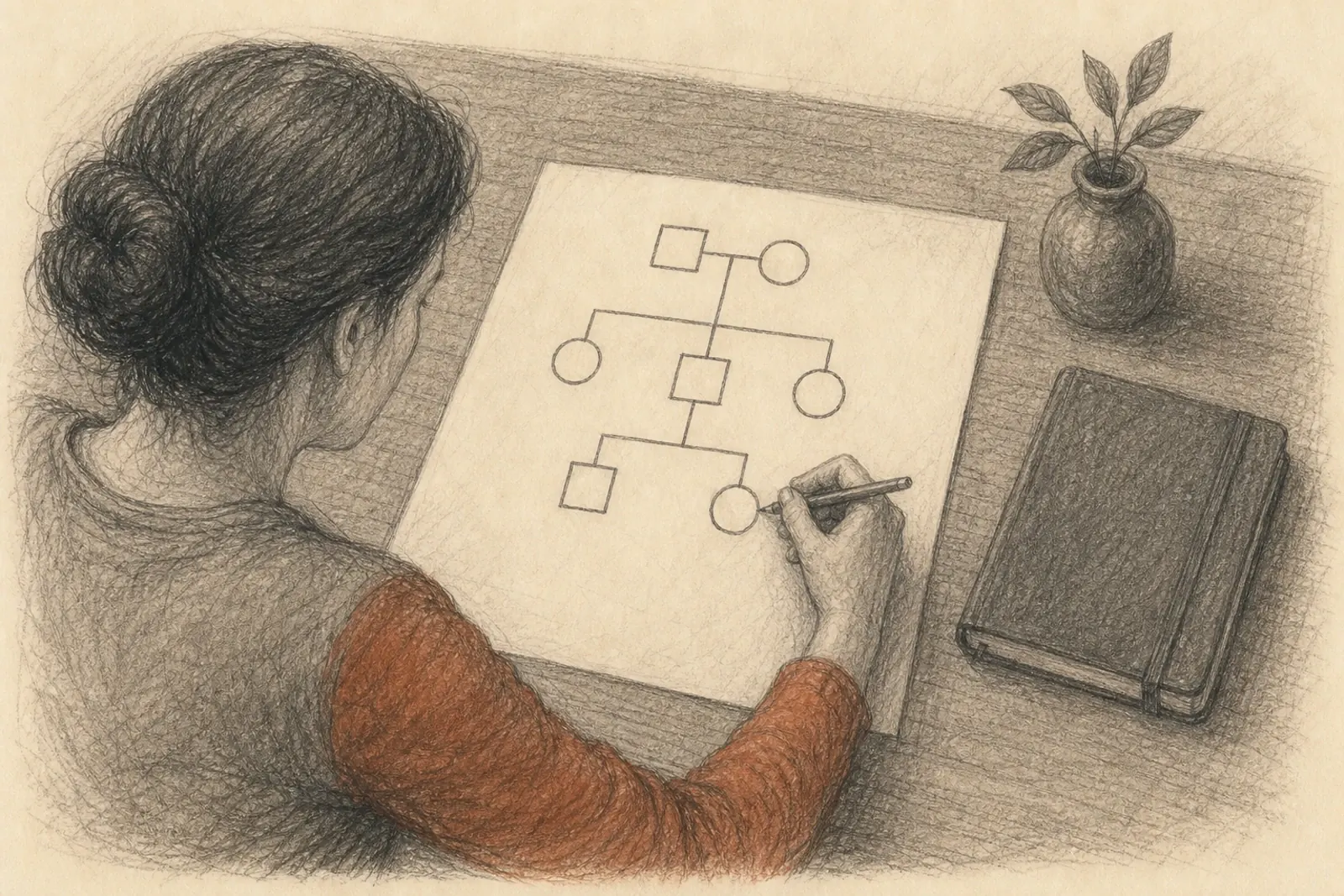
Family constellations work with facts rather than interpretations, so it helps to arrive knowing the shape of your family. Who its members are, across three generations if you can. Who died young, who died in childbirth, who was lost early. Who left, who was sent away, who was never spoken about. Whether there were earlier partners before your parents found each other, and whether anyone was excluded from the family, quietly or loudly. Large events that passed through: war, migration, a business that collapsed, a child given up.
You don’t need dates or a family tree on paper, and you don’t need to know why any of it happened. Names and events are plenty. If your family history has gaps, that’s normal. Bring what you know and leave the gaps as gaps.
Ask a relative if there’s an easy one to ask and there’s something useful you genuinely don’t know. If there isn’t, don’t force it. You do not need to investigate your family before you can come to a workshop.

The week before
Two things, both boring, both worth more than they sound.
Sort out the day itself so that the day is free. Childcare, the commute, whatever normally leaks into a Saturday. A workshop asks for a certain quality of attention, and attention is harder to give when half your mind is somewhere else.
And protect the evening after, if you possibly can. A workshop is a full day of concentrated and sometimes emotional work, and many people appreciate not having to move immediately into another demand afterwards. A quiet evening, a walk, or simply the journey home can give you a little space before ordinary life starts asking for your attention again.
The night before, and the morning of
Sleep, if you can. There are snacks in the room, so you won’t go without. Still, it’s worth not arriving hungry: we start in the morning and it’s a long day.
Wear something you can be comfortable in for a whole day, and that you can move in. You’ll be standing, sitting, kneeling and shifting position, sometimes in the middle of the room. Layers are useful because the room and your own comfort can change over a long day. And if you find shoes distracting, know that people often work in socks; the floor of a constellation room is not a formal place.
Bring a bottle of water and, if you like writing things down, something to write in. A lot of people find they want to note something at the end of the day and have nowhere to put it.
Arrive early
Ten minutes early is worth more than most of the preparation above. Arriving flustered means the first part of the morning goes on catching up with yourself while the room is already forming.
If it helps to know what you’re walking into, what to expect in a workshop takes the day from the opening round to the end.
What you don’t need to do
You don’t need to research constellations before you come. If you want to read, of course you can. There is excellent writing about constellations and some rather strange writing too. Just try not to turn what you read into a script for what your own constellation should reveal or how the day is supposed to unfold. It’s much more useful to arrive curious than to arrive with an expected result.
And don’t worry about preparing what you’ll say. When your constellation comes up, you’ll be asked what the issue is and what you’d like instead. Say it in your own language. It doesn’t need to sound insightful, systemic or particularly well thought through. Finding the useful shape of the question is part of what we do together. And if there is something you would rather not say in front of the group, you can ask to speak with me privately first. It is a normal request and it changes nothing about how the day runs.
If you’re coming online
A day online needs a different kind of preparation: your space, your screen, and how you’ll be in a room that lives in a window. I’ve written that separately in how to prepare for an online workshop, and if you want the whole picture of how a constellation itself runs on a screen, how online constellations work has it. Everything above about your family and giving the day some space still holds.
The dates and the practical details for the days themselves are on the workshops page.