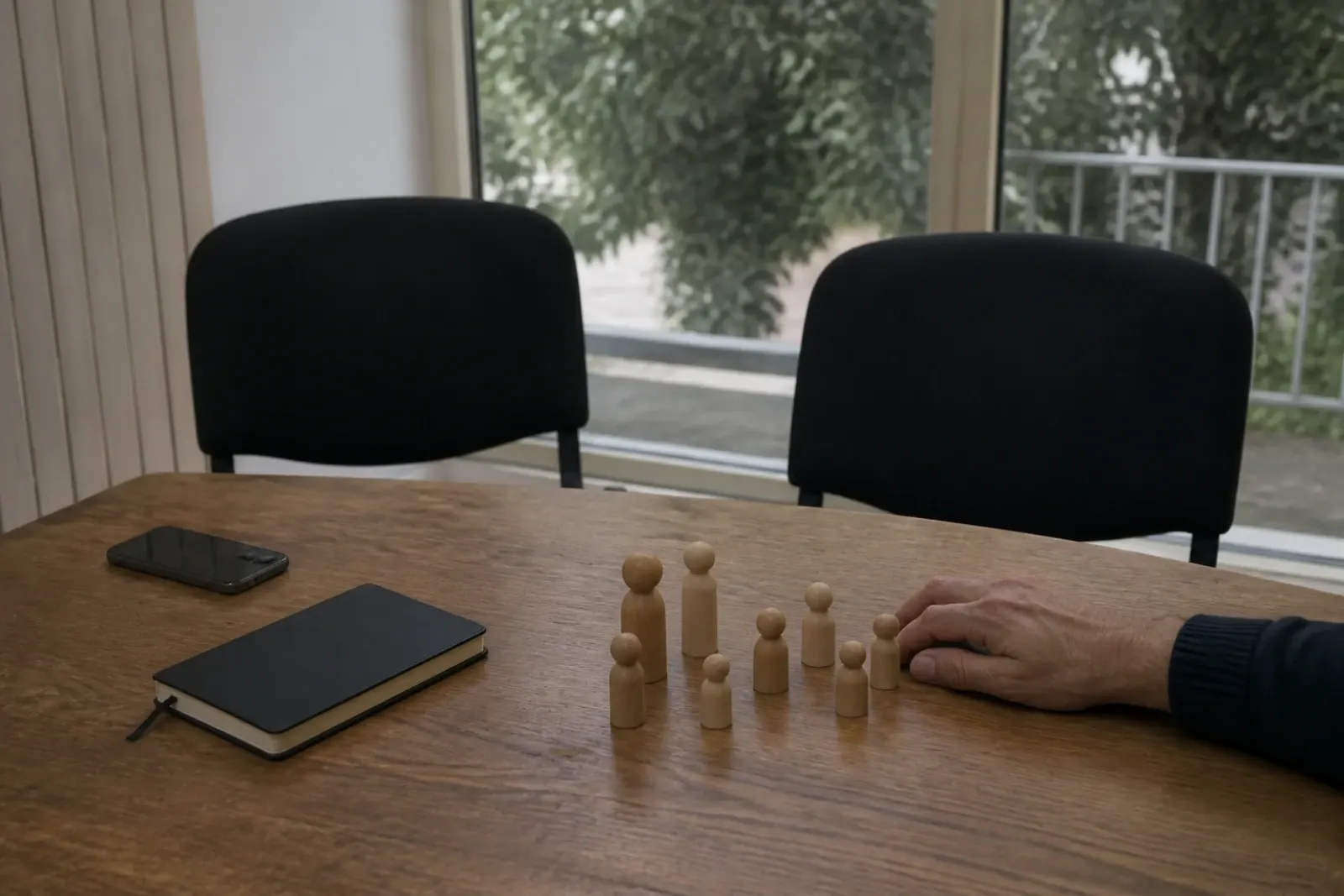
Ask a fifteen year old what is wrong and you may get one word back. Fine. Nothing. I don’t know. Then the door closes, and you are left on the landing knowing perfectly well that it is not nothing. A family constellation can begin without that sentence.
Sometimes they genuinely cannot explain it. Sometimes they know exactly and have no intention of telling you. And sometimes the question itself is the problem.
Think about what “what is wrong” actually asks of a teenager. They have to know what is happening. Find words for it. Decide whether they trust the person asking. Then say those words out loud to an adult, possibly one they met twenty minutes ago. That is four things, and any one of them on its own is enough to close the whole conversation down.
We can start somewhere easier than that.
The work has its roots in working with young people
Family constellations were first developed in the nineteen seventies by Thea Schönfelder, a German child and adolescent psychiatrist. She spent her career working with children and young people, including those who had been through difficult experiences. So although constellations are now widely associated with adults, some of the earliest work grew directly out of a child and adolescent setting.
In that context, the method had an important advantage. You do not have to find the words for everything before you can show something of what you are experiencing. A feeling can become a position, a distance, a direction or a movement. You can notice where you want to stand, who you want to move towards, or what you want to move away from, without first having to explain why.
That can be particularly useful with teenagers. We can start with what they notice, what they feel and where they want to move, and let the words come when they come. The experience does not have to wait for the explanation.
The fuller story is in the history of family constellations.
What teenagers bring
Parents contact me about school. Exam pressure, a report that has fallen off a cliff, a young person who has stopped wanting to go at all. About friendships, about being left out, about being the one everybody has agreed to leave out.
They contact me about attention. A teenager who cannot settle to anything, whose homework takes four hours or never happens, who is bright and is being told they are not trying. Sometimes an assessment is under way and sometimes it is not. I am not the person who diagnoses that, and I would not pretend to be. What I can look at is what it is like to be that person in that family, and everything that has grown up around it.
They contact me when parents separate. Rarely in the first month. Often a year or two later, once the arrangements are settled and everyone has agreed that it is fine now, and something in the young person says otherwise. Two houses. A parent’s new partner, and sometimes new children in the house who arrived without anyone asking. The steady work of never saying the wrong thing about one parent in front of the other. Teenagers do that with enormous loyalty and very little help.
They contact me about distance. A parent in another country. A parent who left and is now an occasional voice on a screen. A young person who came here with one parent and left the other behind, or who lived with a grandmother for years and then rejoined a family they had to learn from the beginning.
They contact me after a move. Migration takes a whole life in one afternoon: the friends, the language, the streets, the version of yourself that everybody there already knew. Teenagers often adapt fastest on the outside, translating for the adults and passing as local inside a year, and that is a different thing from having landed.
They contact me after a death. A grandparent, a parent, a sibling, a friend. Sometimes a death nobody quite spoke about at the time. Sometimes one that happened before this young person was born and that the family has never really put down.
They contact me about illness at home, which quietly reorganises a family around one person and leaves everybody else managing.
And they contact me when there is no event at all. A teenager who went quiet and stayed quiet. Or angry and stayed angry. Who is pulling away from everyone, or who seems to be carrying something the family cannot get near.
Sometimes the young person has a perfectly clear idea of what is wrong. It is simply a different thing from the one their parents came to me about. That is worth finding out early.
I cannot tell you in advance what a session will show, or what will change because of it. What I can offer is a way of starting that does not depend on your teenager producing the explanation first.
What a session looks like
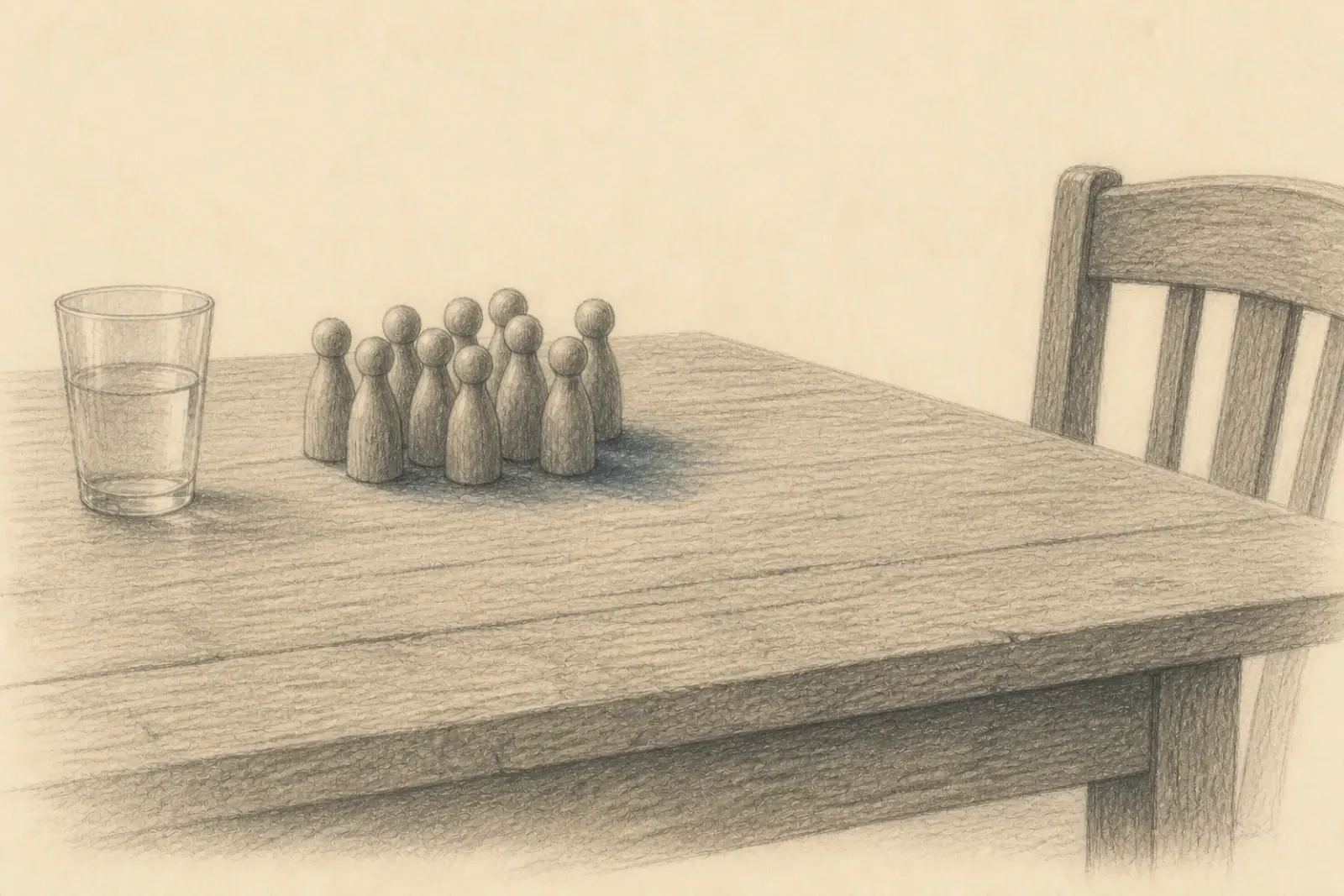
We might sit at a table with a set of figures, and I ask them to choose one for each person who matters and put them where they want them. Or we use the space in the room, or we work online, or in the mind’s eye. The form follows the young person.
Then we start from what is there. The questions stay small.
Who is closest?
Who is far away?
Where are you?
Who are you looking at?
Is that a good place to be?
Would you change anything?
A teenager who has answered “fine” to every question an adult has asked this month will usually answer these ones, because they are answerable. The information is on the table, not inside them waiting to be extracted.
They can say as much or as little as they want about why they put things where they did. I do not need every choice explained, and I am reading the picture with them rather than about them. Whatever it means, they are the one who supplies the meaning.
We might move one figure and see what changes. Sometimes that gives us somewhere to start talking. Sometimes what matters is simply what the young person notices when the picture moves.
And sometimes a teenager does want to talk, once the pressure to explain has gone. Talking is welcome. It just does not have to be the price of entry.
The hour has to become theirs
Before I meet your teenager, I speak with you. I need to know what you have noticed, what has changed, what has happened in the family, what worries you and what you have already tried.
Then you step back.
I would rather they arrived without a briefing on what to say, what you think the problem is, or what you are hoping I will get them to talk about. A young person works out very quickly whether this is the conversation from home continuing in another room with another adult, and if it is, the hour is already over.
What you told me does not disappear. It gives me the context. But the person I am meeting is the one in front of me, and they may see the whole thing differently from you. That difference is part of what we are looking at.
What stays private
Your teenager needs privacy for any of this to be real.
So we are clear about confidentiality at the start, including where it stops. What they tell me stays with them, and I hold that as I would an adult’s, with one limit which I say to them plainly: if something comes up that touches their health or their safety, I will not keep it to myself. I would rather neither of you had to guess about that.
We also agree what, if anything, comes back to you, and we agree it with your teenager present rather than about them.
Sometimes the family belongs in the room
Working with a teenager does not mean the teenager is the one who has to do all the work.
A separation, a new partner, conflict between parents, a death, a migration, an illness, a sibling who needs most of the attention: these change a whole family, and they do not reduce neatly to a problem inside one young person.
So I may suggest working with a parent, or with several of you, or with the family together. We decide that from what is actually happening, rather than assuming that whoever is showing the difficulty must also be the one to fix it.
Afterwards
Leave some room.
Try not to open with “how did it go”, followed by five more questions once the first answer is “fine”. If your teenager wants to tell you something, listen. If they do not, give the hour some space.
They may come back to it days later. They may tell you one small part and keep the rest. They may walk out, forget the whole thing and ask what is for dinner. All of those are fine. You do not have to extract the session from them for it to have been theirs.
If this is your house at the moment
Write to me and tell me what you are seeing. You do not need to know why it is happening, and your teenager does not need an explanation ready either. Tell me what has changed, what worries you, and what a difficult week looks like at home.
We can start from there.
I work in English, Spanish and Portuguese, in person and online.