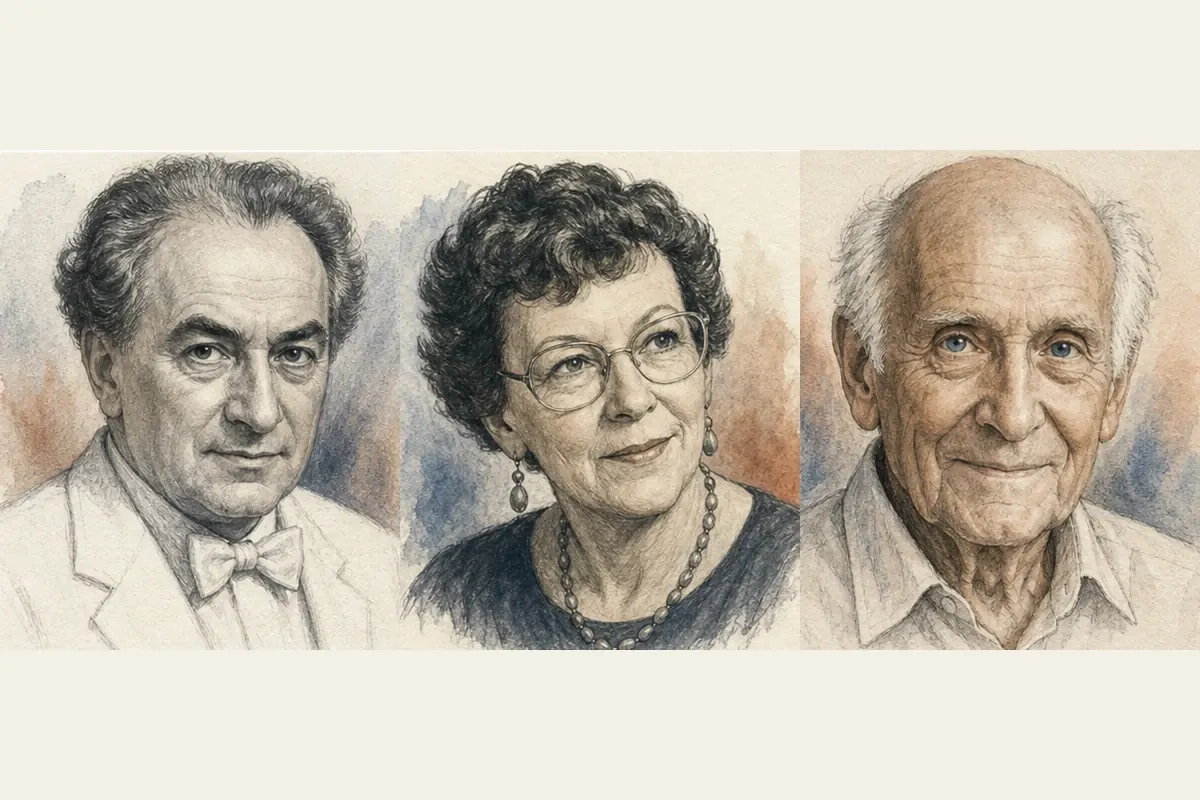
The best-known origin story of family constellations is that Bert Hellinger brought the method back from his sixteen years among the Zulu in South Africa. It’s a good story, and it fits the method’s slightly mystical reputation. But it’s also not true. Hellinger himself described encountering constellation work through other therapists (Hellinger, 2001, p. 438). One of them was a Hamburg professor of child and adolescent psychiatry named Thea Schönfelder.
I teach this history because the version that circulates isn’t just romanticised. It has one man at the centre of something with a much wider lineage. Put that lineage back and the method looks different: not a revelation brought home by Hellinger, but a psychotherapeutic craft that emerged from several developments in twentieth-century therapy. Schönfelder belongs much closer to the centre of that history than the usual account allows. Here’s how we got there.
From the individual to the system
Until the middle of the twentieth century, therapy largely looked at one person at a time. The shift that made constellations possible was therapists beginning to see whole families together, and with that, a new object of attention: not the individual alone, but the individual inside their system.
Three thinkers built much of the theoretical ground this method still stands on. Murray Bowen, an American psychiatrist, was among the first to treat a family as one interconnected emotional unit rather than a collection of individuals, and he described how emotional patterns travel down the generations, what he called the multigenerational transmission process (Bowen & Kerr, 1988). Salvador Minuchin built structural family therapy around boundaries, subsystems and hierarchy, and worked directly with families as their dynamics unfolded in the room (Minuchin et al., 2014). And Iván Böszörményi-Nagy, the founder of contextual therapy, looked across generations at what he called invisible loyalties and the family ledger, the unspoken account of giving, receiving and obligation that can bind a person to their family of origin (Böszörményi-Nagy, 1973). When constellation work asks what one generation may still be carrying from another, it is working in territory he helped map.
The techniques came from two hands
Theory doesn’t put anyone in a room. The techniques came from elsewhere.
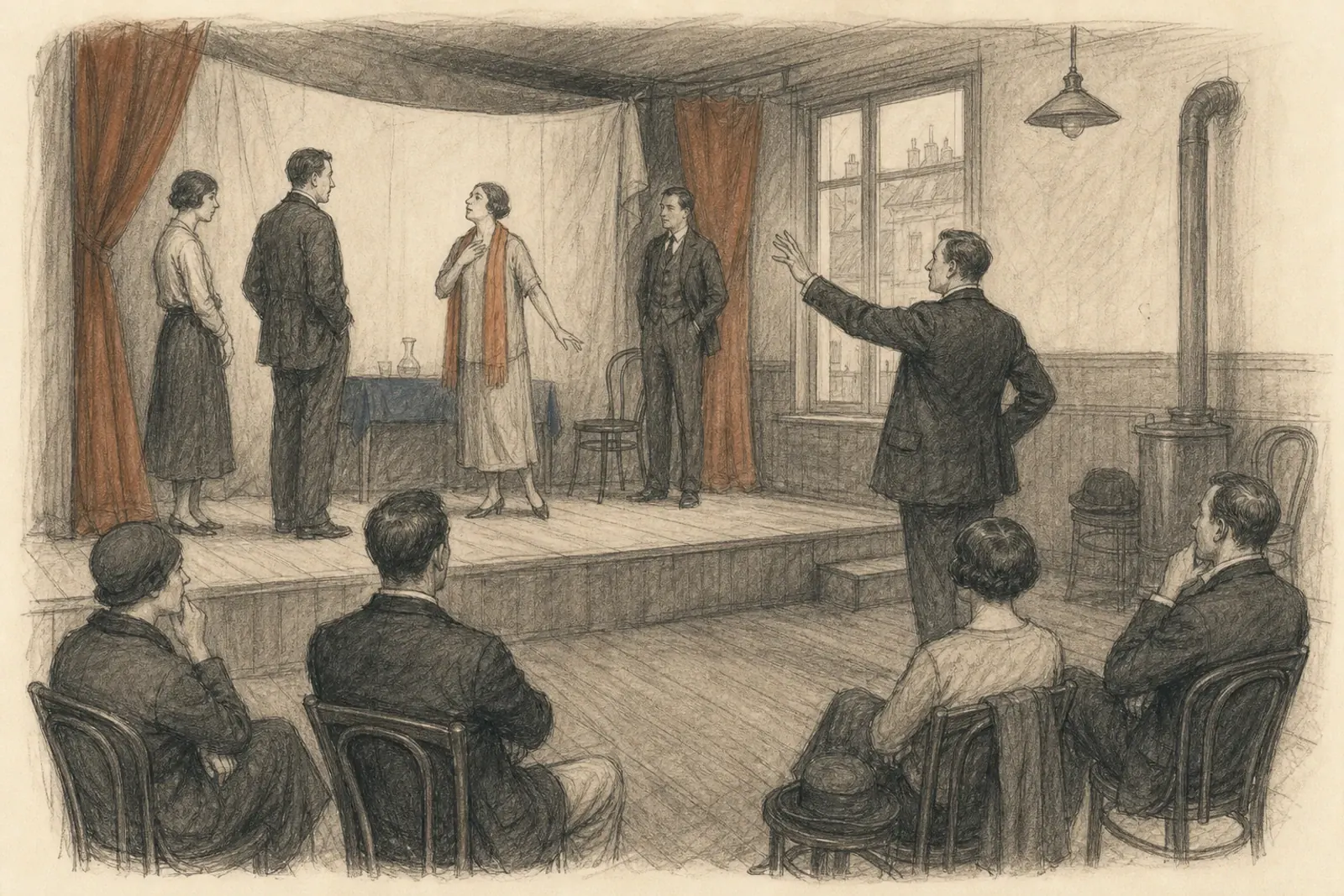
Jacob Moreno, the founder of psychodrama, was among the first to have people enact their relationships in a group instead of describing them from a couch, with group members taking on roles in another person’s relational world (Franke, 2003/2017, p. 48). He established one of the crucial precedents for what constellations would later do: using other people, in space, to make a relational system visible.
Virginia Satir carried spatial work with the family much further. Satir, one of the founders of family therapy, worked with family sculpture: asking a client to arrange family members physically in the room, close or distant, turned toward or away, so the shape of the relationships could be seen instead of only talked about. It arrived by accident in 1962. The family Satir meant to interview turned up with people missing, so she used chairs for the absent ones. Later she had an assistant stand in instead. What she found was that if she put people into physical stances, they were likely to experience the feelings that went with that stance (Franke, 2003/2017, p. 61).
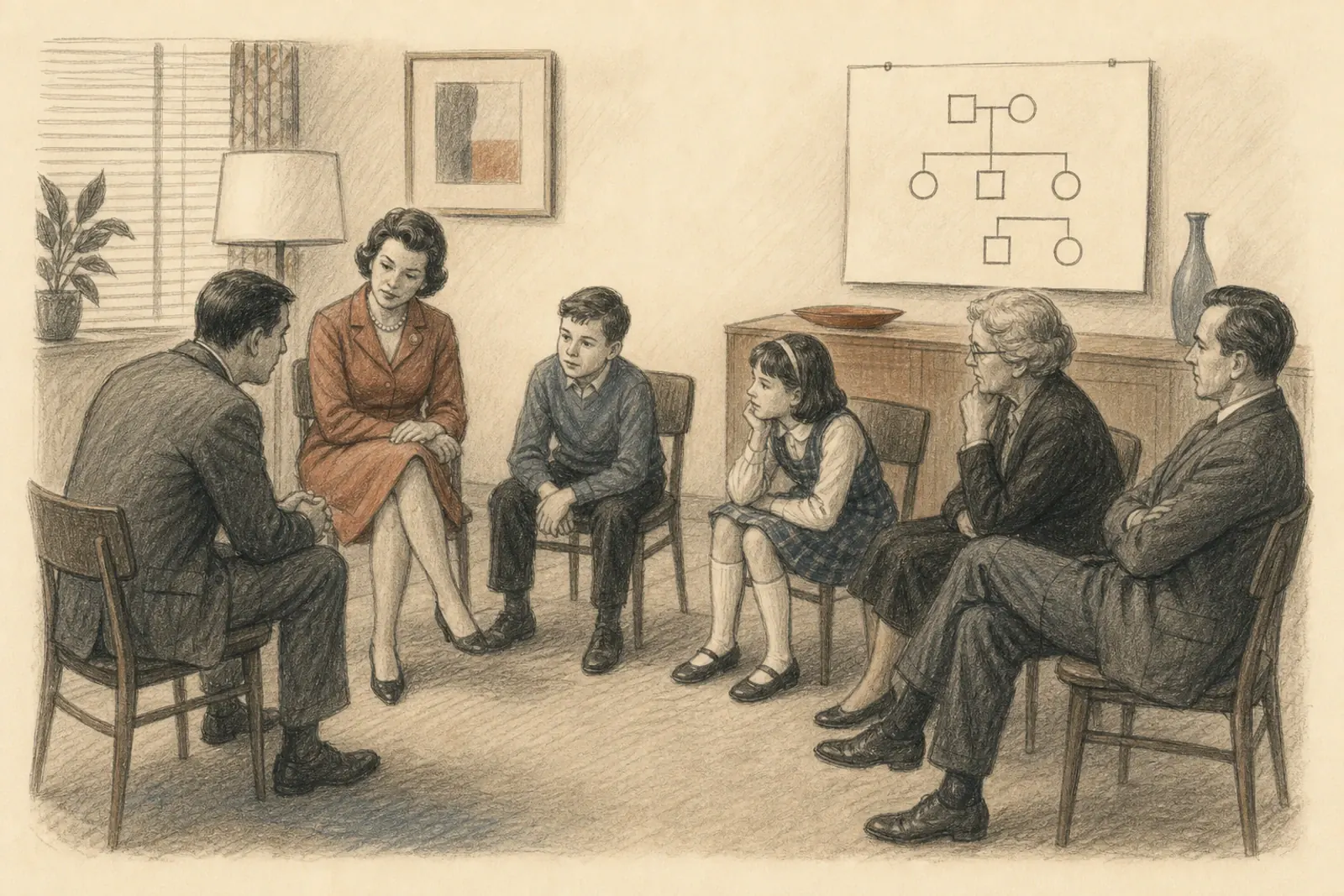
Read that again and you’ve read much of the technical vocabulary of a family constellation: the spatial image, people standing in positions, reports from inside those positions, interventions in the arrangement. What didn’t yet exist was the particular method that would grow from these ingredients.
Thea Schönfelder, who put something new together
Thea Schönfelder (1925–2010) is the foremother of family constellations, and the record on this is clearer than her obscurity suggests.
She was a pioneer of German psychiatry. She began at Hamburg’s university clinic in 1958, and in 1970 she was appointed to its chair in child and adolescent psychiatry, becoming the first woman in Germany to hold a professorship in that field. She kept the position until 1987. Her clinical work included children and adolescents who had experienced abuse, alongside a wider commitment to child and adolescent psychiatry.
In the early seventies, while holding that professorship, she trained in Concentrative Movement Therapy, CMT (Schönfelder & Struve, 2012). CMT combined a psychodynamic framework with deliberate movement, bodily perception and spatial exploration, often in groups. Participants could take positions in a room and attend closely to what happened in their experience there, while the therapist facilitated and checked in. Its phenomenological discipline is captured nicely in one detail from Schönfelder’s account: rather than moving immediately to an interpretation such as “I am terribly depressed”, the participant could stay first with what was directly happening, “I am crying”. Experience before interpretation.
Satir’s family sculpture was also circulating through the family-therapy world. Schönfelder brought that spatial way of representing a family together with the embodied attention she had learned through CMT. In the supervision groups she later described, a case was presented, people represented members of the family, positions were set without explanation, representatives were asked what they perceived where they stood, and interventions were introduced to see what changed. Whatever name we give it retrospectively, this is already recognisable as family constellation work (Schönfelder & Struve, 2012).
Where she used it matters. The method developed in supervision. Therapists brought difficult cases, members of the group represented people in the family, and Schönfelder checked what happened in the different positions while trying interventions one at a time. She later brought the method into her own clinical practice. She also worked one to one, setting figures out on what she called the family board. Individual constellation work, without a room full of representatives, was therefore present very early in the method’s development. It isn’t simply a later adaptation of the group form.
So why does almost nobody know her name? Three reasons, each ordinary and together decisive. She developed constellations only in the last decade of her career, which had been dedicated, before and after, to child and adolescent psychiatry. As a woman holding a singular position of power, she judged, probably correctly, that publishing findings so far outside the accepted therapy of the day could threaten that position. So she didn’t write it up; she taught it, in workshops, to many therapists, and let the method travel by hand. Only at her retirement did she contribute to a book on CMT that gives us a window into how she worked (Schönfelder & Struve, 2012).
One of the therapists who encountered her work was Bert Hellinger.
Hellinger, precisely
What Hellinger did and didn’t do both deserve stating exactly, because he’s neither the founder the legend claims nor a footnote.
He came to therapy late: sixteen years as a Catholic missionary and school director in South Africa, followed by extensive therapeutic training in Europe and the United States. Around the end of the seventies he encountered constellation work in more than one place. He participated in Schönfelder’s workshops, including as a representative. He also trained with Ruth McClendon and Les Kadis, an American family-therapy school working in the Satir tradition (Hellinger, 1998). By the early eighties Hellinger was conducting constellations of his own (Schönfelder & Struve, 2012), and across the nineties and two-thousands it was largely through him that the method reached a wide public, first in the German-speaking world and then internationally.
His sixteen years among the Zulu did shape his thinking, by his own account (Hellinger, 2001, p. 442). They did not give him the constellation method. That distinction matters because it changes the story from one of cultural revelation to one of development inside an already active therapeutic field.
Hellinger built a philosophical theory around what he observed, drawing notably on Böszörményi-Nagy (Hellinger, 2001, p. 444). His writing repeatedly organised relationships through ideas such as guilt and innocence, belonging, order and balance, and gave these principles a much more fixed status than later constructivist approaches would. Some of his observations about recurring dynamics in families remain influential. Much of the theoretical structure he built around them has dated.
The controversies around Hellinger are part of this history too. Political statements interpreted by critics as antisemitic, together with conservative positions on family and sexual orientation, led many therapists, particularly in Germany, to distance themselves from him (Sparrer, 2016, p. 44). The weight moved from the method to the facilitator. Facilitation, in Hellinger’s words, was a calling, and that framing travelled widely. Some of the workshop-certificate culture the field still lives with grew from there. In the later phase of his work, constellations moved still further from psychotherapy and toward explicitly spiritual practice. That history helps explain why the method is still so often encountered as esoteric even though many of its roots lie squarely inside twentieth-century psychotherapy.
The ones who grounded it
While Hellinger carried constellations to a much wider audience, other practitioners were systematising, challenging and extending the method.
Insa Sparrer and Matthias Varga von Kibéd, a psychologist and a philosopher, developed systemic structural constellations, SySt, from the eighties onward. Their approach was explicitly constructivist where Hellinger’s became increasingly doctrinal, and placed constellation work inside a worked-out therapeutic and philosophical framework (Sparrer, 2016). They also carried the method beyond the family into professional systems, decision structures and other abstract questions.
Ursula Franke gave the method another kind of grounding. Her doctoral work traced its historical and therapeutic roots through figures including Satir, Böszörményi-Nagy and Moreno (Franke, 2003/2017), contributing to a scholarly account of a method whose history had often travelled orally. In her practice and writing she also developed individual constellation work into a rigorous form of its own (Franke, 2017), where Hellinger was best known for working with large groups.
Ursula Franke and Thomas Bryson, at ISPAB in Munich, later became Cecilia’s and my own teachers. Cecilia translated Franke’s books, including In My Mind’s Eye, her foundational text on constellation work in the individual setting. That lineage runs directly into the method we teach now: systemic, therapeutic, and phenomenological in Schönfelder’s sense, with experience observed before it is turned into interpretation.
Why the true history matters
Not for fairness alone, though restoring Schönfelder to the history is overdue. It matters because the two origin stories produce very different ideas about what this method is.
Tell the history as a charismatic ex-missionary’s revelation and it becomes easy for authority, intuition and calling to dominate the culture around the method. Trace it instead through psychodrama, family therapy, contextual therapy, family sculpture, movement therapy and clinical supervision, and a different picture appears. This is a craft that developed through psychotherapy, which means it can be taught, questioned, refined and improved.
That doesn’t make Hellinger unimportant. It puts him in the history rather than making him the history. And it puts Thea Schönfelder back where the surviving record suggests she belongs: not as a footnote to Hellinger, but as a practitioner who was already doing recognisable constellation work before the method became synonymous with his name.
Sources
- Böszörményi-Nagy, I. (1973). Invisible Loyalties.
- Bowen, M., with Kerr, M. E. (1988). Family Evaluation. W. W. Norton.
- Franke, U. (2003/2017). The River Never Looks Back. Carl-Auer.
- Franke, U. (2017). In My Mind’s Eye: Family Constellations in Individual Therapy and Counselling (C. Beaumont, Trans.). Carl-Auer.
- Hellinger, B., with Weber, G., & Beaumont, H. (1998). Love’s Hidden Symmetry: What Makes Love Work in Relationships. Zeig, Tucker & Co.
- Hellinger, B. (2001). Love’s Own Truths: Bonding and Balancing in Close Relationships. Zeig, Tucker & Theisen.
- Minuchin, S., et al. (2014). The Craft of Family Therapy. Routledge.
- Struve, M. (2012). Interview with Thea Schönfelder on the beginnings of family constellation work, originally conducted in 2002. Praxis der Systemaufstellung.
- Sparrer, I. (2016).