Skip to content

Family constellations training

Become a facilitator people feel safe with

A three-year training to become a family constellations facilitator, live online and in a small group. You learn the whole method: how to see what is happening in a family, how to set up a constellation, and how to stay steady in the room while it unfolds.

Request the programme

Constellations in a nutshell

Five plain answers to start with

What it is

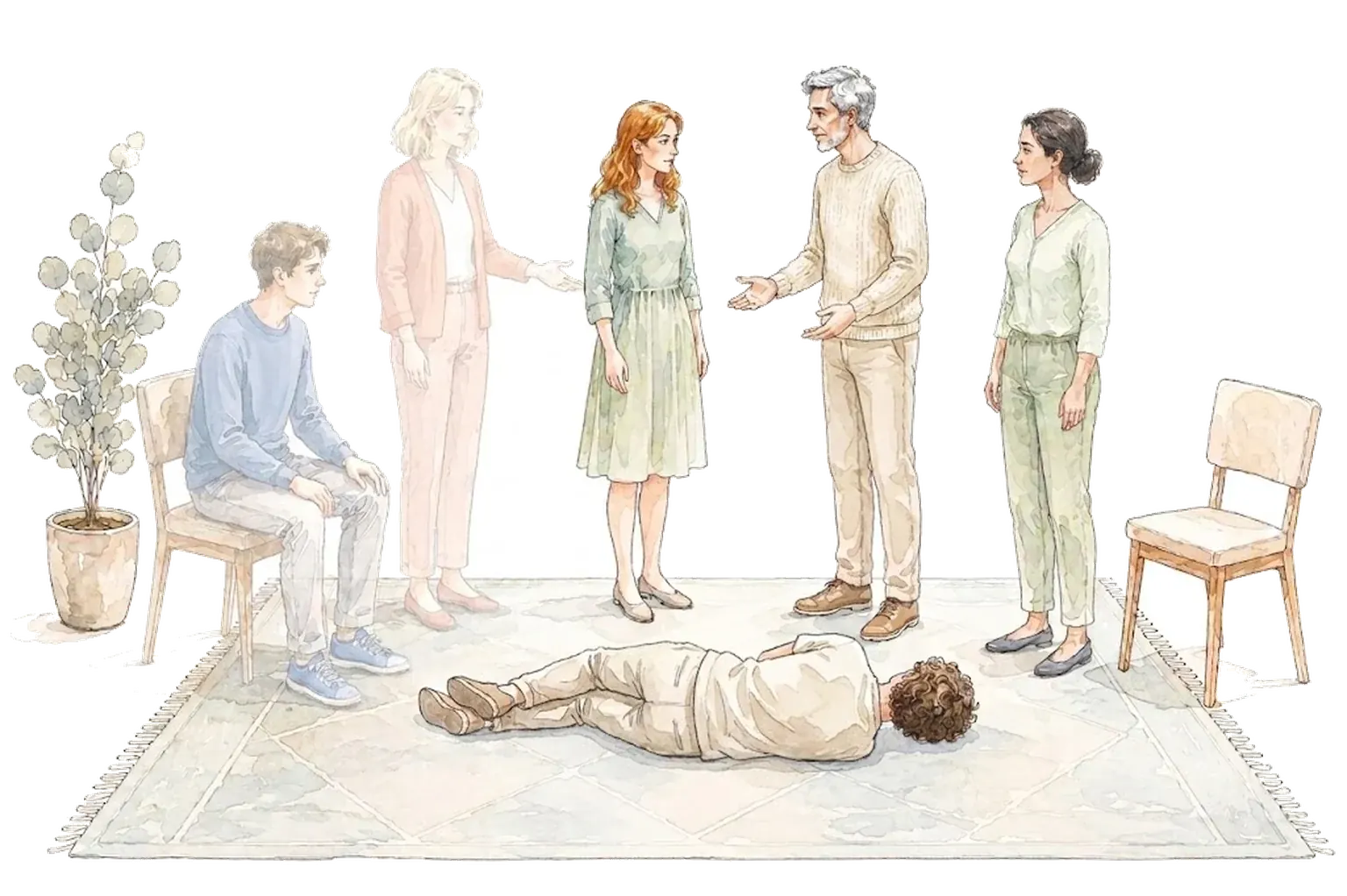
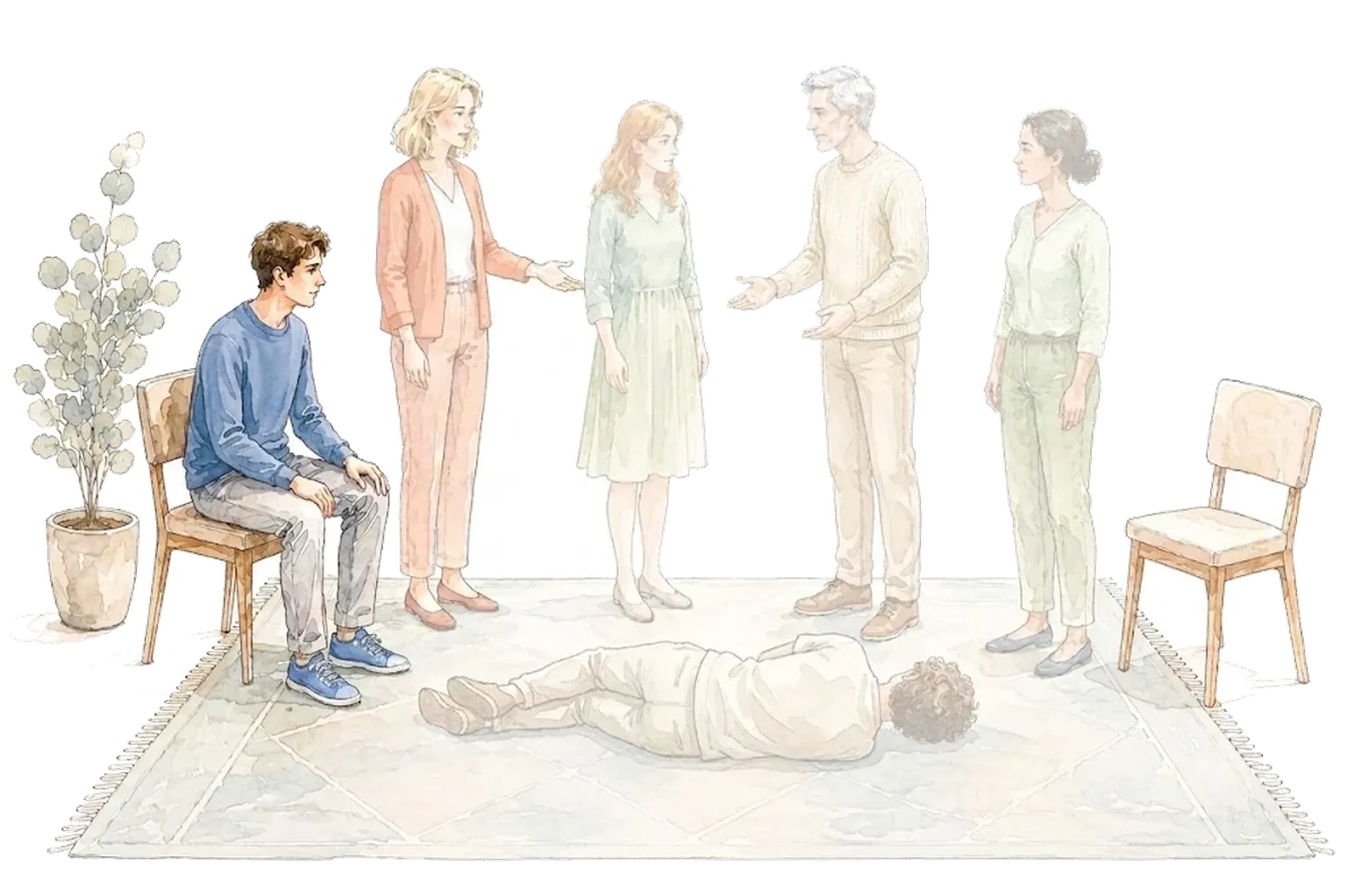
A way of looking at a difficulty in the wider system it belongs to. Instead of only talking about what is happening, you give the important people or elements a place in relation to one another, so the pattern becomes something you can see and work with.

Where it comes from

Constellation work grew from systemic family therapy and several therapeutic traditions in the second half of the twentieth century. The team works systemically and phenomenologically: starting with what is actually there, reading the relationships between the parts, and staying curious about what the picture might mean.

What happens

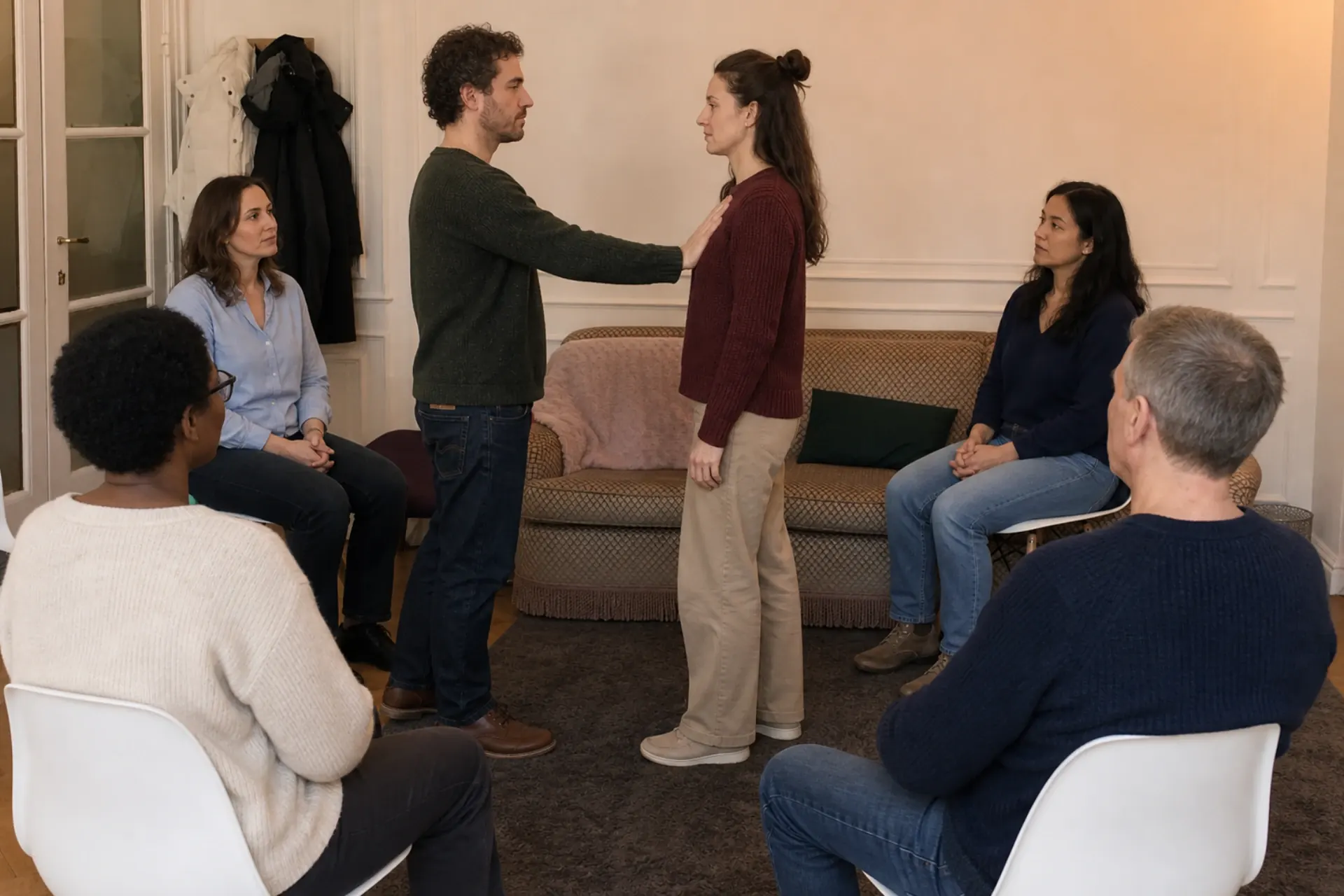
You begin with a question, difficulty or something you want to change. The people or elements that belong to it are given a place. From there, you look at the relationships, test small movements and follow what changes in the system.

What is asked of you

For a constellation, you will need 3 things: a question or issue you want to explore, a goal you want to work towards, and the relevant facts about your life and family history. You do not need to prepare the whole story; what matters is the information that connects to what you are working on.

Why we constellate

You can understand a pattern very well and still find yourself living it. A constellation lets you work with it as an experience, not only an idea: seeing the relationships, feeling different positions and trying what happens when something changes.

Who it's for

Four ways in

People come to this training from very different places. These are the four we see most.

Family constellations, taught as one method.

The Al-Ma Model is our name for the method itself, and the three years are built so that each part rests on the one before. By the end you are not copying a teacher. You are facilitating.

The Al-Ma Model

Four frameworks, one method

Each framework answers a different question: what you are seeing, how you work with it, how you meet the client, and how you develop as a facilitator. Together they form the Al-Ma Model, trauma-informed and client-centred throughout: paced to what people can hold, and led by what the client brings.

Explore the Al-Ma Model →

Free introductory webinar

Meet the training live

Come and see the training before you decide. In two hours we introduce the programme and do a first constellation exercise together, live. You will have met the way we teach before you commit to anything. No cost, no obligation.

24 September 2026 · 18:00 to 20:00 Brussels time That is 18:00 CEST where you are.

Curriculum

The three years

Three years, in sequence: learn to read the system, learn to facilitate within it, then deepen and extend your own practice.

Year 1 · Semesters 1 and 2

Reading the system

You build the systemic foundations: learning how to create safety, take a relational stance and read the dynamics shaping a person, family or wider system.

10 modules

Semester 1 Foundational Safety and Stance

You begin with the conditions that make systemic work possible: creating safety, understanding the field, working trauma-informed, developing your therapeutic stance and learning to map a family across generations.

  • Creating a Safe Space
  • Exploring the Field
  • Working Trauma-Informed
  • The Therapeutic Stance
  • The Genogram
Semester 2 Foundational Reading the System

You learn to read a family system through the Systemic Tree, moving from survival and belonging through structure, balance and individuation to understand how patterns take shape and persist.

  • Survival
  • Belonging
  • Structure
  • Balance
  • Individuation

Year 2 · Semesters 3 and 4

Running constellations

You move from reading systemic dynamics to working with them: learning the full constellation process, practising facilitation and applying the method to the themes people most often bring.

10 modules

Semester 3 Foundational The Craft of Constellating

You learn the complete craft of facilitation: opening the field, interviewing, forming and testing hypotheses, intervening, and bringing a constellation to a close in both individual and group settings.

  • Opening the Field
  • The Interview
  • Transforming the Field
  • The Individual Setting
  • The Group Setting
Semester 4 Advanced Core Themes

You deepen the method through recurring themes in systemic work, learning how different dynamics appear around ritual, grief, health, money, success, love and couple relationships.

  • Rituals
  • Death, Mourning and Grief
  • Illness and Health
  • Money and Success
  • Love and Couples

Year 3 · Semesters 5 and 6

Mastering

You broaden your range and deepen your judgement: working with inner systems, expanding beyond family constellations and developing a practice that is increasingly your own.

10 modules

Semester 5 Advanced Inner Work

You turn the systemic lens inward, working with inner representations, parts, timelines and individual practice to understand and transform systems within the person.

  • In the Mind’s Eye
  • Inner Parts I
  • Inner Parts II
  • Healing the Timeline
  • Individual Practice
Semester 6 Advanced Beyond the Family

You take systemic constellation work beyond the family, applying it to decisions, problems, groups and structural questions while bringing the three years together into a practice of your own.

  • Structural Constellations
  • Taking Decisions
  • Problem and Miracle
  • Group Practice
  • My Future with Constellations

Request the full programme by email →

The programme

Every module, in full

All six semesters and every one of the 30 modules, how the training runs week to week, how facilitation develops, supervision, certification, what taking part involves and what it costs.

We'll email you the link to the full programme.

How it runs

How the training works in practice

You meet live online each week, in the same small group and the same weekly slot. If you can get to Brussels, the weekend workshops there are open to you in person, included in your training fee.

In person · Brussels

If you can get to Brussels

Most people do this training entirely online, from wherever they live, and it is whole that way: the full method, the full three years, nothing held back for a room. If you are in Brussels, or can travel here, you can also come to our weekend workshops in person, included in your training fee. Same group, same training, one more way to be in it.

Fees and certification

What it costs, and what you earn

You can join for a semester, for a year, or for the whole three years. Each commitment has its own monthly rate, and the people on the full track hold a fixed place in the group for all three.

One semester

  • Six months of the training: one full semester, five modules
  • The full content of that semester, taught with the group
  • Above the first semester this buys the content, not progress towards certification
Request the programme

One year

  • Two semesters, ten modules, taken as one commitment with the same group
  • The full content of the year
  • Certification requires the full three-year track
Request the programme

The full track

  • A fixed place in the same small group across the full three years
  • 3 years, 6 semesters, 30 modules
  • The only route to the EISEC certificate
  • A transcript at 12, 24 and 36 months
  • Supervision from the second year, and a place in the alumni network
Request the programme

Request the full programme →

EISEC

European Institute for Systemic Education & Coaching

Raising the standard of constellation work

EISEC exists to increase the level of quality within the field of systemic constellations. That means training facilitators in more than technique: in the theory behind the method, the way you hold a client, practice under supervision, and the responsibility that comes with facilitating other people's processes.

2017

Training facilitators since

20

Groups taught

5

Dedicated teachers on faculty

360+

Live hours with faculty across the training

Your teachers

Who you'll learn from

The training is taught by practitioners who facilitate, teach and continue to develop the method themselves.

Cecilia Altieri

Cecilia Altieri

Co-founder and Director

Has trained facilitators all over the world.

Meet Cecilia →
Simon Maebe

Simon Maebe

Co-founder and Head Trainer

Did his first constellation at sixteen, and has been learning the method ever since.

Meet Simon →
Anca Florea

Anca Florea

Trainer

Part of the very first training group, and has facilitated constellations since 2017.

Meet Anca →
Xilo Espinoza

Xilo Espinoza

Trainer

Came to constellations through her own healing, and now brings that lived understanding into her facilitating and teaching.

Meet Xilo →
Mina Kanashiro

Mina Kanashiro

Trainer

Practising since 2018, and works in four languages.

Meet Mina →

From the people who did it

What students say

The next group

A group forms around the people in it

We do not set a start date and ask everyone to fit around it. The group forms around the availability of the people joining it, and the date is confirmed once enough of them have applied.

Registration open

Registration is free and non-binding. Tell us which weekly times could work for you, and we use everyone’s availability to shape the next group.

Reserve your place
About the next group

Questions, answered

What about my time zone?
Each group has its own weekly slot, chosen around the time zones and availability of the people forming it. The joining page shows the current options and practical details.
How much time should I budget?
Allow three hours for the live class each week, plus your own practice between sessions and any workshops you choose to attend.
What if I miss a class?
The material stays in your classroom, and if you need to make up a module, you can join it with a later group.
Do I need special software or equipment?
A standard browser, a good pair of headphones, and a stable connection. Nothing to install.
What language is it taught in?
English. The group is international by design.
Do I need previous training?
No. You do not need to be a therapist or coach, or to have studied constellations before. What matters is your motivation for learning this and your readiness to engage with it.
Can I use it in the practice I already run?
Yes. If you already work with people, the systemic thinking and relational stance can begin informing your practice long before you are ready to facilitate a full constellation.
Will I be prepared to facilitate?
Yes. You begin facilitating inside the training partway through the foundational stage, and by the end of it you can take a constellation from the opening question to the close. Supervision runs alongside that. Working with people outside the training comes after the second year.
How is the training kept safe?
It is trauma-informed from the first module. Safety and the relational stance come before any technique.
How long can I access the material?
It stays in your virtual classroom, including after you finish.
When do groups start?
There is no fixed intake date. A group is confirmed once enough people have applied and a weekly slot works across the group. Places go in the order applications arrive, not the order people registered.
Can I take a single year or semester?
Yes. You can join for a semester or a year without committing to the full three years. You receive the complete teaching for that period, but only the full track leads to certification.
What do I get when I finish?
The EISEC certificate, a yearly transcript of your work, and a place in the alumni network.

See the training in full

You have the overview. The full programme takes you through every semester and module, how progression and supervision work, what certification requires, and the practical detail of taking part.

Request the programme

Trouble with the booking widget?