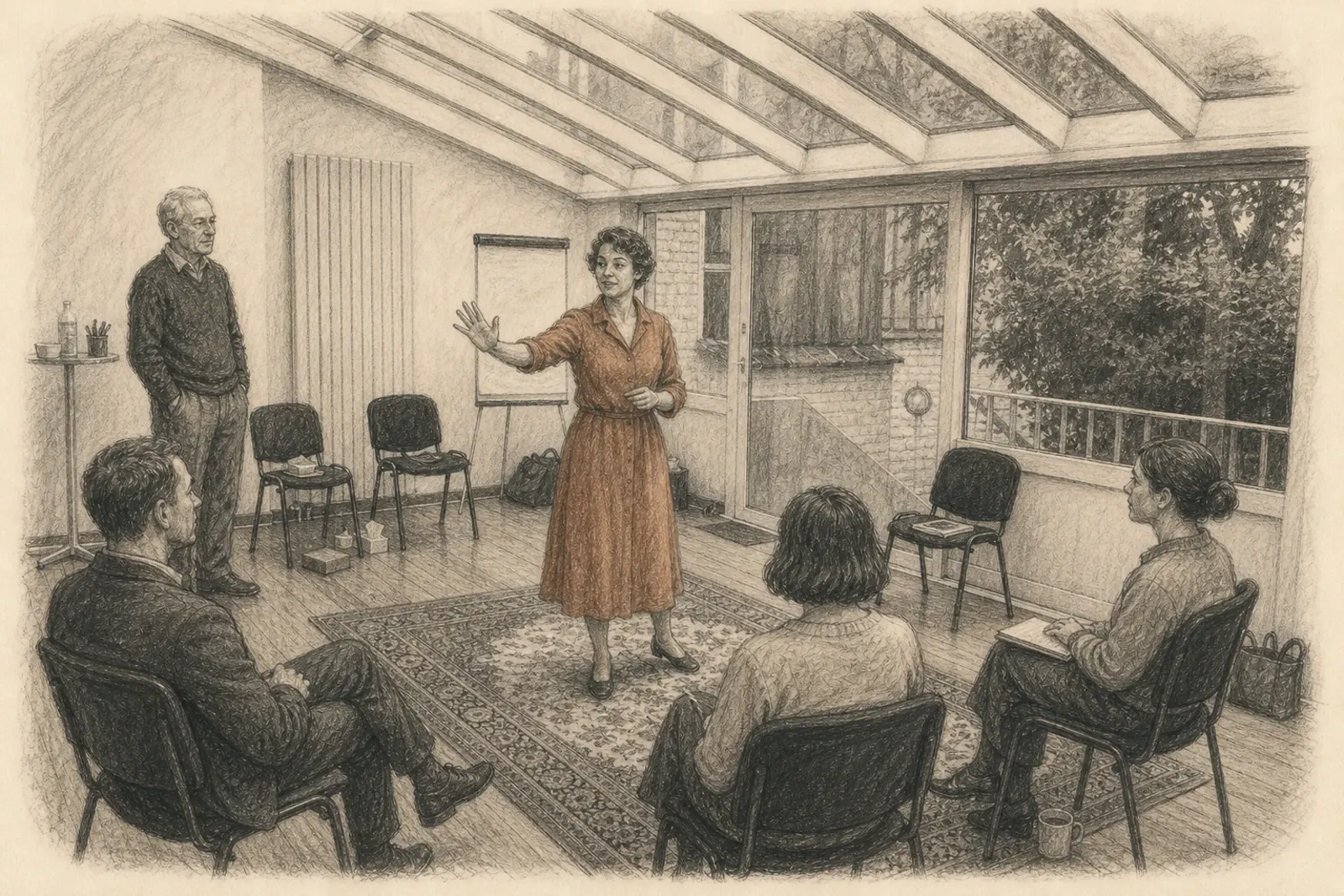
The question I’m asked most often about becoming a family constellation facilitator is whether you need to be a therapist first. The answer is no. Therapists come to this work with useful skills, but facilitation asks for a combination of capacities that very few professions teach together.
I’ve trained people who arrived as therapists, coaches and counsellors, and people who came from somewhere else entirely. They don’t start in the same place. Some are immediately good at connecting with a client. Some see patterns in a system remarkably quickly. Some are comfortable holding a group or staying with uncertainty. Almost nobody arrives equally strong in everything. A large part of becoming a facilitator is learning what you already bring, what you still need to develop, and how to bring those capacities together.
What a facilitator actually does
From the outside, a constellation can look deceptively simple. Someone brings an issue, representatives are placed, things begin to happen, and the facilitator asks questions or suggests movements. But the facilitator is actually doing several jobs at once.
You are holding a conversation with the client, trying to understand what they are really bringing and what they want instead. You are listening for patterns and forming hypotheses about the system. Once the constellation begins, you are following placements, movements and what representatives report. At the same time, you are staying connected with the client, noticing what is happening in the room, managing the group, and keeping track of whether the work is actually moving somewhere useful.
And throughout all of that, you have to remain in your place as facilitator. You can become absorbed in what a representative is experiencing and lose the client. You can become so interested in your hypothesis that you stop seeing what is actually happening. You can feel pressure to produce a resolution and start pushing the constellation towards one. Holding the whole while not taking it over is much of the craft.
Notice what isn’t part of the job: having answers to other people’s lives. The client stays the expert on their own life from the first minute to the last. The facilitator brings attention, questions, hypotheses and craft, not verdicts. Seeing patterns in people and families can be a real strength. Understanding gives you the lay of the land and helps you guide the process, but it doesn’t tell you where the client should go. The facilitator can open possibilities, ask questions and help make something visible. The steps forward remain the client’s to make.

Presence, emotional attunement and analytical thinking
Underneath the individual techniques, I think a good facilitator develops three qualities: presence, emotional attunement and analytical thinking.
Presence is the capacity to stay here, with yourself and with the client, while several things may be happening at once. It means noticing your own reactions without being pulled away by them, tolerating silence and uncertainty, and not rushing simply because you don’t yet know what comes next.
Emotional attunement is the capacity to notice what is happening emotionally in yourself and in the people around you, and to stay connected to it without collapsing those experiences into one. You need to sense what may be happening for the client, listen carefully to what representatives report, and remain aware of your own emotional responses at the same time. The skill lies not only in perceiving all of that, but in distinguishing it. What belongs to the client? What is a representative reporting? What is happening in you? They are all information, but they are not automatically the same information.
Analytical thinking keeps the wider picture in view. What patterns and dynamics are becoming visible? What hypotheses fit what you know so far? What changed after an intervention? Are you still working with the issue the client brought? Where might there be a useful next step? A constellation can contain a great deal of information. Someone has to keep track of the whole.
Very few facilitators begin equally strong in all three. Some see a pattern almost immediately and can find a way forward through remarkably quick analysis. Others arrive there through emotional attunement, by staying closely connected to the client and to what is emerging in the constellation. Both can produce excellent work. Ideally, with experience, you learn to use both while developing the presence that lets you move between them without losing yourself, the client or the wider system.

Where people start from
This is one reason people can arrive at constellation training from quite different backgrounds. A therapist may already be comfortable building a relationship, interviewing and staying with difficult emotion. A coach may be used to listening for goals, asking precise questions and keeping movement in view. Someone who has worked with organisations or groups may see structures and patterns quickly and know how to hold several relationships at once. Someone coming through embodied or relational work may already have a particularly fine sensitivity to what is happening in the room.
None of those backgrounds makes someone a constellation facilitator. But they can mean that part of the work is already familiar. The task then becomes developing the capacities that are less familiar and learning to bring everything together.
Experience working with clients helps for the same reason. If you have already worked one to one or with groups, you may know how to build trust, remain present while someone is struggling, listen without immediately intervening, hold boundaries and keep your own reactions from taking over the work. Those capacities are not specific to constellations, but having them already gives you more room to concentrate on the parts that are.
Having an active practice helps too. Not because you need one to begin, but because you can put what you are learning into practice much faster. Something understood in training becomes a different kind of knowledge once you try to use it with another person. You practise, discover what you missed, reflect on it, bring it to supervision and try again. That cycle accelerates learning enormously.
If you don’t have a professional practice, that doesn’t prevent you from developing. Peer groups give you somewhere to practise regularly, and friends and family can sometimes provide additional opportunities for exercises and practice work. It takes a little more deliberate organisation, but what matters is that the learning doesn’t remain theoretical.
There is also one strand nobody gets to skip: your own work. You bring your own family system into every room you facilitate. A facilitator who hasn’t learned to recognise their own patterns is much more likely to encounter them in a client’s constellation and mistake them for information about the client. Your inner work isn’t preparation for the training. It’s part of learning the craft, all the way through.
The path
If becoming a facilitator is somewhere on your horizon, I’d start by experiencing constellations from every seat you can.
Have a session. Attend a workshop. Above all, represent, more than once. Taking representative positions in other people’s constellations is one of the best first classrooms this work has. You learn from the inside what it is like to notice something before you can explain it, what happens when a statement lands, how a movement changes the picture, and whether constellations still interest you once the novelty has worn off.
Then train properly, in a method coherent enough that you can understand why you are doing what you are doing rather than collecting interventions. Practise while you learn. Watch other people facilitate. Let them watch you. Bring the moments where you got lost into supervision, because those will often teach you more than the sessions that went smoothly.
And expect the learning to continue past the certificate. Real cases, supervision, further study and your own ongoing work continue to change how you facilitate. In our framework we call the whole arc the Facilitator’s Path, and we mean the name. It’s a path, not a threshold you cross on graduation day.

What to look for in any training, including ours
If you’re comparing trainings, I would look closely at four things.
Length and practice. Facilitation is a craft learned by doing, under eyes that can catch what you can’t yet see. Short courses have their place. They can show you the landscape, give you some vocabulary and help you decide whether you want to go further. What they can’t do is give you enough repetitions to integrate everything a facilitator has to hold at once. That takes supervised practice, work on your own material and time. Ours runs three years for that reason, but the principle isn’t peculiar to us. The German Society for Systemic Constellations, the DGfS, requires recognised facilitator training to run for at least two years, with substantial practice, supervision, peer work and personal process built in. Serious training in this field is measured in years, not weekends.
A coherent method. Ask any training one question: what, exactly, will I be taught? A programme sampling many teachers’ approaches gives you breadth and leaves much of the integration to you. We made the other choice: one method taught whole, the Al-Ma Model, developed and refined across years of running this training. Theory, technique, stance and the development of the facilitator are designed to fit together. Neither approach is inherently better, but they are different kinds of training, and you should know which one you’re choosing.
Trauma literacy. Constellations can reach difficult material, sometimes quickly. A facilitator needs to recognise overwhelm and dissociation, pace an intervention, and know when to slow down, stop or refer. A training that leaves that out is teaching you to drive without brakes. Ask how a training teaches this and listen for a concrete answer, not simply reassurance that it does.
Your own work, built in. Technique alone is not enough when the person using it is part of the instrument. Look for a programme in which personal process is part of facilitator development rather than an optional extra alongside it. The point isn’t to become a person without patterns. It’s to know your own well enough that they don’t quietly start directing someone else’s constellation.
If it’s ours you’re weighing
Then two links do the work better than more prose from me. The training page sets out the programme itself. And because our groups form around the participants’ real calendars rather than a date we picked, I’ve written separately about how a group forms and gets its date. Registering interest is free and binds you to nothing, and the discovery call checks fit in both directions. A training this long should be entered the way it’s taught: with clarity about what you’re stepping into, and a real choice about whether to.