
Skip to content

The training

How a group forms, and gets its date

Simon Maebe about 6 minutes

Adults gathering into a new facilitator-training group

Before a new training starts, we can build almost everything it needs. We can create the curriculum, prepare the teaching platform, organise the programme, bring together the training team and make the infrastructure ready. What we cannot build in advance is the group.

That part begins when we open the doors. We do not yet know exactly who will come through them, where they will be joining from, or which weekly times will be possible across the group that eventually forms. There is some uncertainty in that, and we would rather make it visible than pretend it is not there.

Forming a group this way is how we work with that uncertainty in practice. It lets people join from different countries and time zones, shows us where their availability overlaps, and gradually turns a collection of individual registrations into one group that can actually train together.

First, we find the weekly time

A group needs one weekly meeting time that works for everyone in it. When you register, we show you the available slots in your own timezone. You simply tick every one you could realistically attend, including the alternatives that would also work.

As more people register, those answers begin to overlap. A particular weekly time may start to gather several people around it, while another may turn out not to be workable for the group that is forming. We can see that pattern developing and use it to find the strongest shared option.

This is why registering while a group is still forming matters. You are not reserving a seat simply by registering, but your availability becomes part of the picture from which the weekly schedule is built.
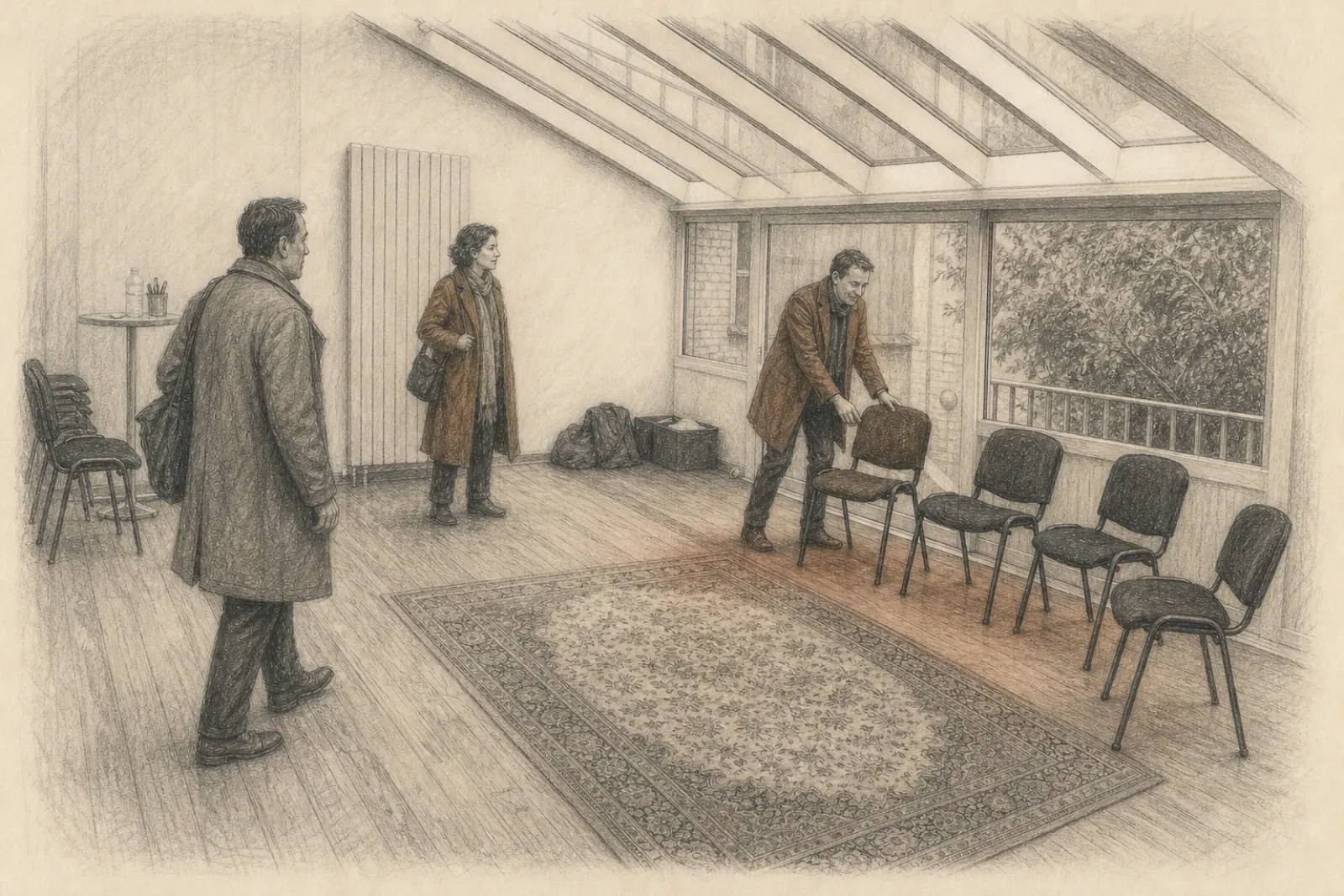
Drawing of adults arriving separately in the workshop veranda while one chair is moved into the beginning of a circle

Then the group forms around a start window

We publish possible start windows in advance. These give everyone something concrete to plan around while leaving enough room for the group itself to finish forming.

Autumn

last week of October

Now forming

Winter

first week of February

Fallback

Spring

first week of May

Summer

first week of September

The start window gives the forming group something concrete to work towards, but it becomes confirmed only once enough people have completed the process.

If the group is not ready for the window it was forming towards, we move to another available window and continue. We do not want to manufacture certainty where there is none. The training starts when there is actually a group ready to begin.

You can see the group forming as we see it

Some uncertainty is unavoidable when a group is still forming, but that does not mean the process has to be unclear. The tracker on this page is part of how we keep it transparent. It shows where the group stands, using the same practical information we are working with.

It moves through three stages. First, registration is open while people are joining and adding their availability. Once the group is ready to move forward, applications open. When enough applications are complete, the group is confirmed. Applications can then remain open until all twelve places are taken.

The tracker updates as the group changes, so you can see where things stand rather than having to guess whether anything is happening. As availability begins to overlap, the leading weekly time becomes visible. Once the date is confirmed, the timing and the remaining places are shown there too.

You do not need to keep checking it. If you have registered, we send updates when the group moves to a new stage, when a start period is confirmed, or if it moves to a fallback window. The tracker is there so that whenever you do look, you have the same picture we have.

Where this group stands

Registration open

Registration is free and non-binding. Tell us which weekly times could work for you, and we use everyone’s availability to shape the next group.

Register for free Book a discovery call

That is where the group now forming stands. The tracker moves with it, while the thresholds that carry it from one stage to the next stay the same.

What makes a group ready

A group needs a minimum of eight people to begin, and it can grow to a maximum of twelve. Two numbers decide when it is ready to move forward, and they count different things.

The first is registrations. Once eight people have registered, there are enough people in the forming group to open applications. Everyone who has registered and completed their discovery call is sent an invitation code.

The second is applications. Once eight people have completed an application, the minimum group size has been reached and the training can begin. That is the point at which the start window can be confirmed and the weekly meeting time fixed.

Places go in application order rather than registration order. Registering puts you among the people forming the group, but it does not hold a place. Someone who registers later and completes their application first can therefore take a place before you. Places are capped at twelve.

Registering still matters before applications open. It puts your availability into the scheduling process while the weekly time is being found, and it puts you among the people who receive an invitation code once applications begin. Registration itself is free.

There is also a practical protection once you do commit. If the start window or weekly time changes after you have applied and paid, you can choose a full refund or carry your payment forward to the next start. You should not have to carry the financial risk of a scheduling decision that remains ours to make.

What you actually do

The process has seven steps. Registering is free and binds you to nothing. Registration and the discovery call can happen in either order, and payment is only asked for when you apply.

You do this

Free, and it binds you to nothing. You leave your details and say you are seriously interested.

Nothing on that path is asked of you twice, and you can stop after any step and return later.

Drawing of three different coats hanging together on a row of hooks by a door, chairs just visible in the room beyond

Why we do not treat a group as twelve empty seats

A group is not simply a set of places to fill. It is what people study, practise and do experiential work inside. Before that can happen, it has to work on two levels.

The first is practical. Enough people need enough shared availability for one weekly time to work. The second is fit. The training asks people to learn closely together, and not every programme is right for every person at every moment.

That is why the discovery call comes before the application. It is a conversation in both directions. You can ask what you need to know, and we can look together at whether the training and the forming group make sense for you before anyone commits.

What we can make certain

We can make the training itself ready. We can decide what we teach, how we teach it, who teaches it, how the programme is structured and what standard we work to. We can build the platform, publish the steps and make the joining process clear.

What we cannot decide is who will be ready to join at the same time, or whether the people who arrive will share enough availability to become one workable group. Those are not failures of planning. They are simply the parts of forming a group that depend on other people.

What we can offer is transparency about what is happening. The start windows are published, the joining steps are clear, and the tracker shows the state of the group as it changes. You do not have to rely on us saying that a group is coming together. You can see what stage it has actually reached.

If you are considering joining, you do not need to wait for every detail to be settled before registering. Registration is the step that lets your availability become part of the group we are trying to assemble. Everything you need, including the current start window, registration, availability picker and application process, is on the next-group page.