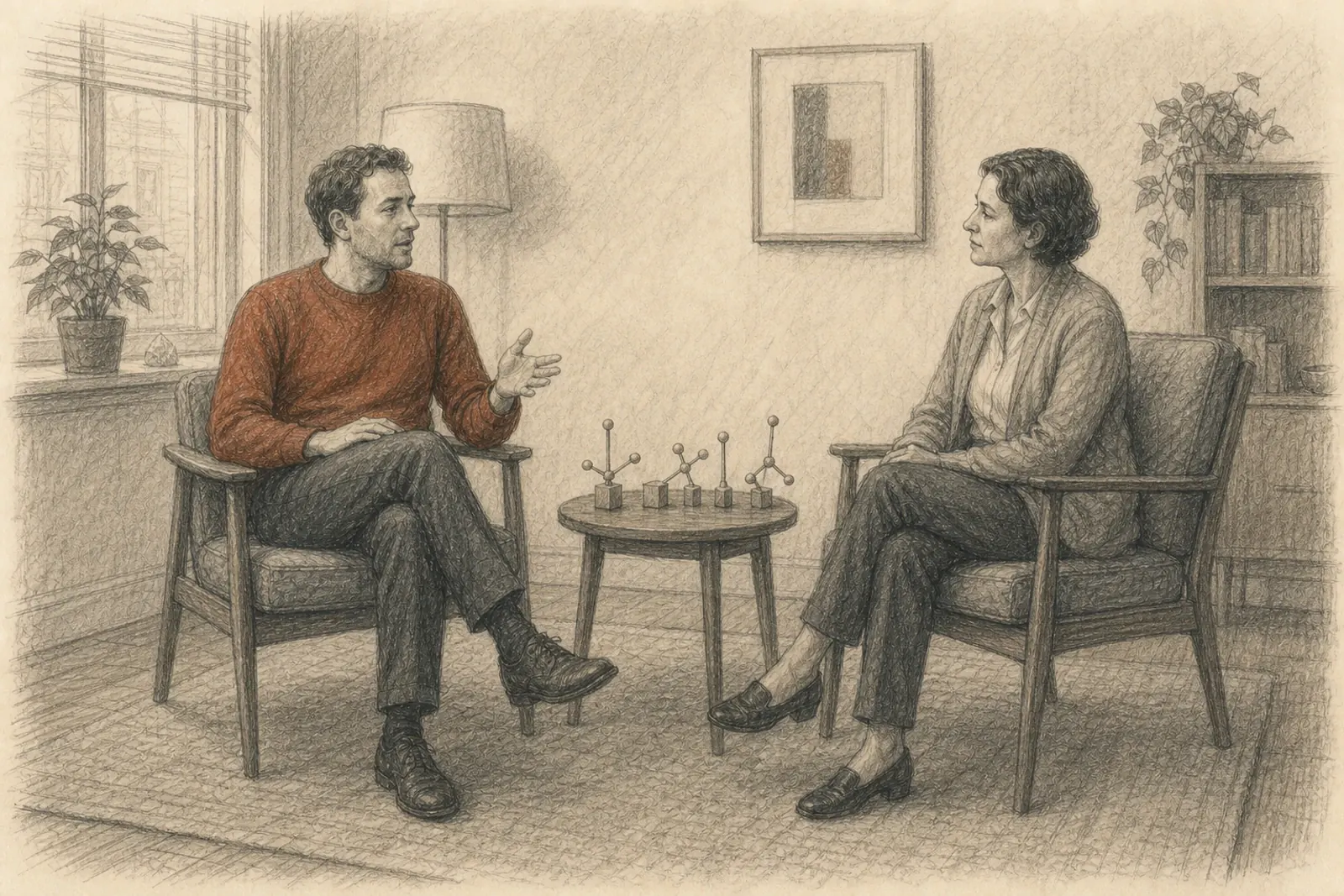
On my table there’s a set of deliberately plain stones and a small turntable. In a cupboard, felt mats for the floor. Sometimes we use those. Sometimes we work in a dedicated online space. And sometimes the whole family constellation happens somewhere with no equipment at all: in your own imagination, with me asking questions like “How far away do you see her?” and “Where do your eyes go?” Which form we use depends on you and what we’re exploring.
If you’ve booked a first session, or you’re deciding whether to, you probably want to know what’s actually going to happen to you. So let me walk you through it honestly, including the part most descriptions skip: what happens when there isn’t time for everything, and why that’s fine.
It starts as a conversation, and the conversation is the work
The first part of a session looks ordinary from outside. We talk. You tell me what brings you, and I help you get it clear: what exactly hurts or feels stuck, and what you’d want instead. Your words, not mine. Because that’s where their meaning lives.
I want to say something about this part, because people often treat it as the queue before the ride. It isn’t. The clearer we get about what hurts and what you want instead, the more coherent the rest of the session tends to be. Some of the most useful sessions I’ve held were conversation from start to finish, and I’ll come back to why.
I’ll also ask about your family, plainly and factually. Who’s in it, what happened when. You decide what you share. I’m not hunting for anything; I’m sketching the map we’ll work on.
Then we make the picture
This is the part that’s genuinely different from talking therapy. Instead of only discussing your situation, we set it out where you can look at it.
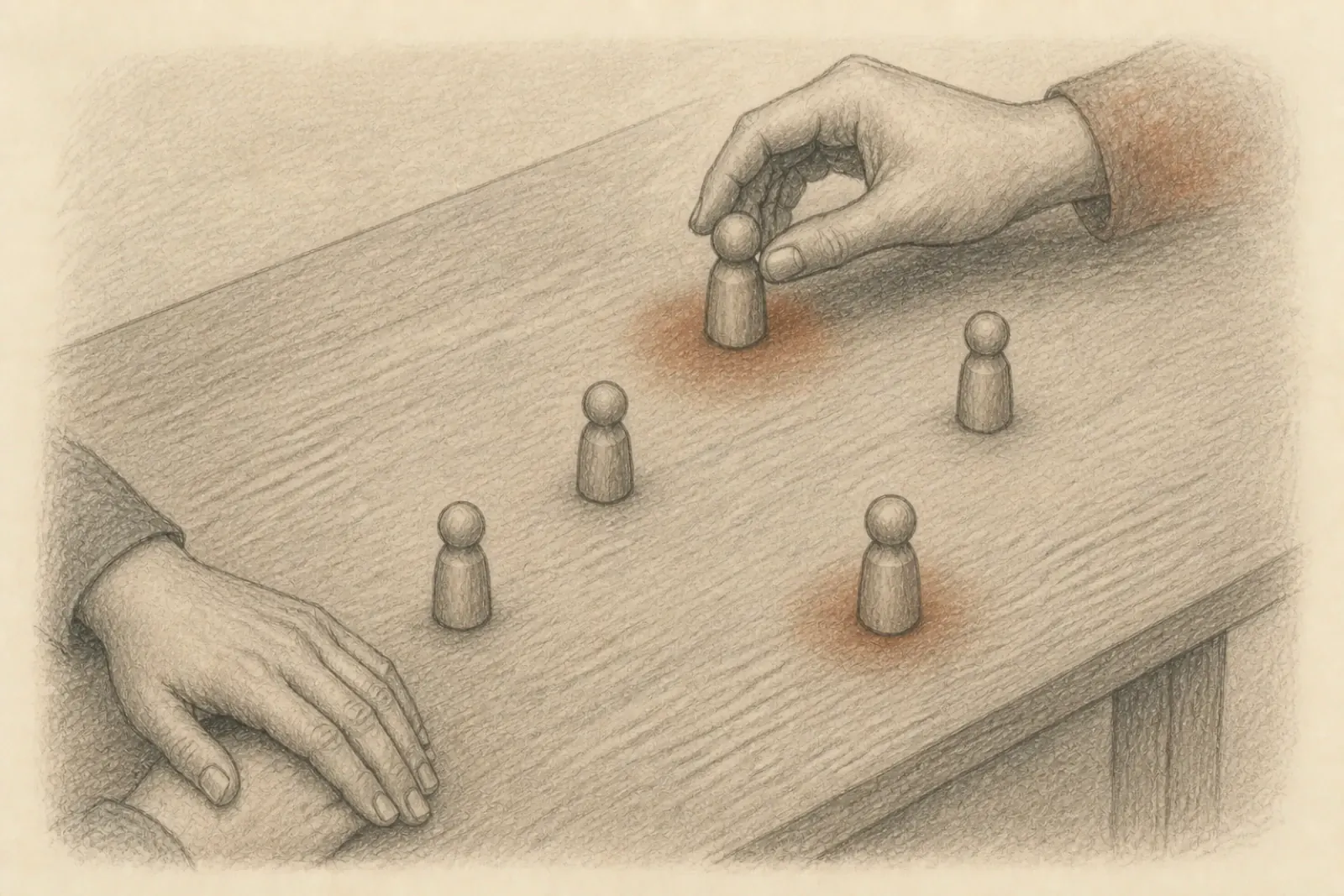
In person, that might be those stones on the turntable, each one standing for someone in your family, placed at distances and angles that fit your inner picture. Or felts on the floor you can physically stand on, to feel what the world looks like from your mother’s place. Online, we can work in a dedicated online constellation space, or purely in the mind’s eye. Mental imagery can evoke very real emotional and bodily responses, which is one reason this way of working can feel surprisingly immediate.
However the picture takes shape, we work with what begins to appear. I’ll ask what you notice, where your eyes want to go, what happens in your body when someone moves closer. When I suggest something, it’s an offer: “Would you be willing to try standing there?” You can always say no, and the no is information too, often some of the most useful information in the session.
One thing I hold to firmly: whatever appears in the picture is how the system feels from where you stand, not a verdict on your family. A constellation shows feeling, not fact. Nobody gets accused; nothing gets diagnosed.
Three ways a session honestly ends
Sessions have edges, and I’d rather you know the real shapes than expect a movie.
Sometimes the conversation reaches clarity early, and there’s room for the whole arc: a picture built, explored, gently shifted, brought to rest somewhere freer than it started.
Sometimes clarity takes longer, and we do one focused piece instead: a single movement tried, one hypothesis tested, with a proper ending rather than a rushed one.
And sometimes the conversation is the whole session. We reach the end having only mapped the ground, and the constellation waits for next time. I said I’d come back to why that’s fine: being helped to see your own situation more clearly, through careful questions and another perspective, already changes what you are looking at.
Which of the three you get isn’t a grade. It’s the session finding its honest size for that day.
Before we finish
We take time to land before the session ends, so you leave settled rather than stopping at the sharpest point. Whatever we’ve opened, the last stretch is for coming back: feet on the floor, the room around you, what stays open named plainly so it isn’t rattling around unnamed on your way home.
The session doesn’t really end when it ends. People write to me about something that settled into place days, weeks, sometimes months later. A quiet session that lands on Thursday counts just as much as a dramatic one that peaks in the room.
If you’re thinking about coming, I’ve written separately about how to prepare, and everything practical lives on the sessions page. And if your honest next step is just a question, ask it.