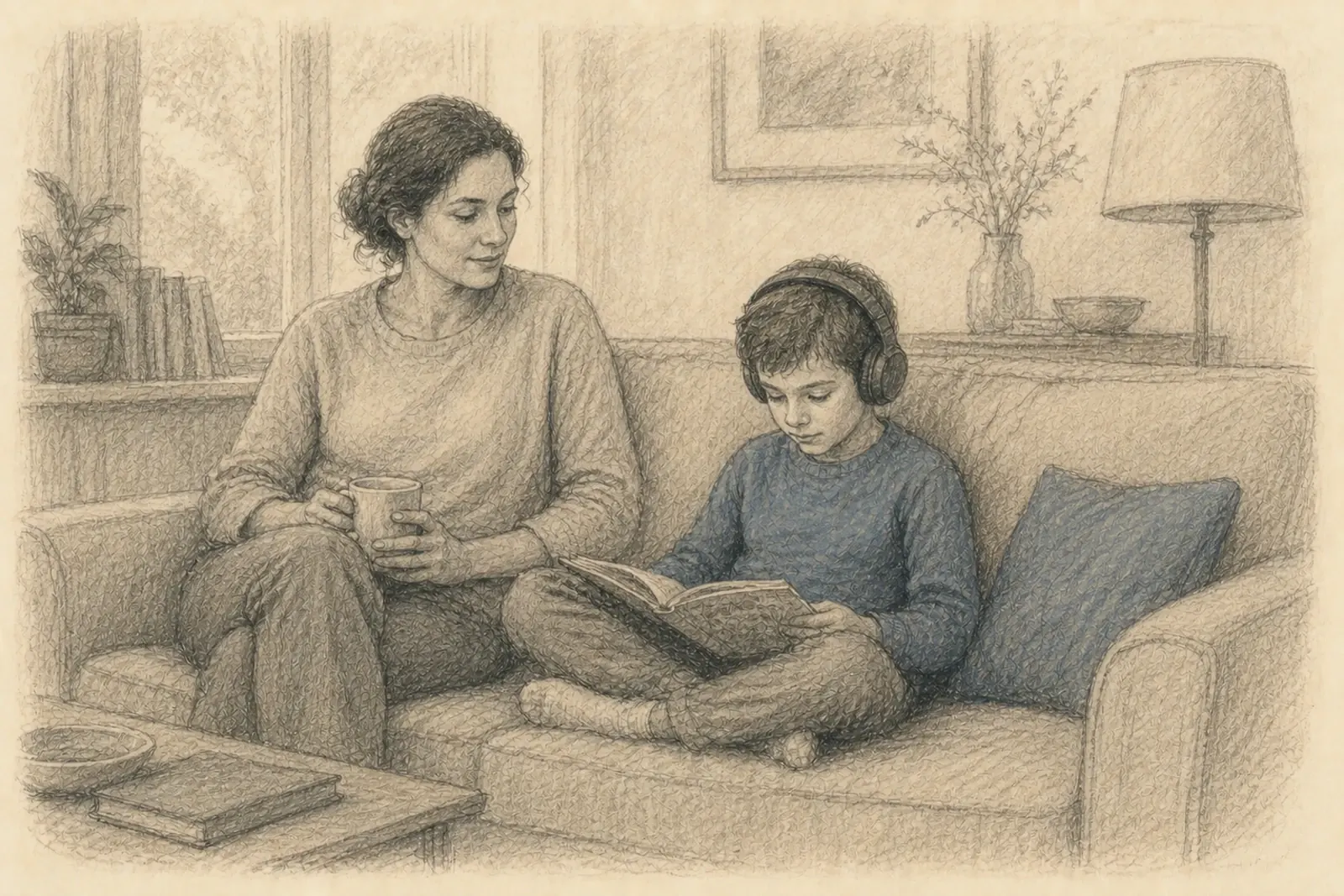
Here is what the Safe and Sound Protocol can actually look like in a home. A child sits on the sofa in comfortable over-ear headphones, listening to music for about a quarter of an hour. A parent is nearby, doing nothing special. That’s the whole visible event, and it repeats over time at a pace I set for that particular child.
Parents who write to me usually ask about the music: what it is, what it does, and whether it is suitable for their child. Those are good questions, and I answer them properly on the listening therapy page. But another question matters just as much, and people ask it less often: what do I do while my child listens?
Quite a lot, although very little of it looks like doing.
Your presence matters
Children learn regulation in relationship. A familiar adult’s face, voice and presence can help a child settle, especially when something feels unfamiliar, demanding or intense. Long before children can explain what is happening inside them, they are already orienting to the adults around them.
You know this from ordinary life. A toddler falls over, looks up, and checks your face before deciding what happens next. That sensitivity to the people around us does not suddenly disappear as we grow. So when a child is doing something new with their body and attention, having a familiar adult nearby can make the experience feel much easier to manage.
That’s why the parent in the picture above is doing something after all. Your presence is one of the cues your child keeps orienting back to.
What the listening is, briefly
The Safe and Sound Protocol uses specially filtered music designed to emphasise features of sound associated with human vocal communication. The listening is sequenced and filtered in a particular way, which is why it is followed in order rather than treated like an ordinary playlist.
There are different listening pathways and music options, and the pace is adapted to the person rather than simply following the programme as quickly as possible. There’s no lower age limit. I work with babies, with older children and with adults.
That’s as much mechanism as this post needs. The full picture of how a course runs is on the listening therapy page.
What you actually do
Before anything starts, we work out together whether this suits your child. It begins in writing, so you can tell me about your child with time to think, and then we meet. I’d rather tell a parent honestly that this isn’t the right tool, or not the right moment, than start something that doesn’t fit. Nothing begins until we’ve both decided it makes sense to try.
You make the listening ordinary. A quarter of an hour, somewhere comfortable, at a time of day that suits how your child’s day actually runs. No performance, no pressure to notice something, no expectation that the child has to react in a particular way. The more ordinary and low-pressure it feels, the easier it is for many children to engage with. Some families fold it into something that already exists in the day.
You stay nearby. Not watching like a hawk, which most children feel immediately, but present the way you might be while they are drawing and you are reading. Your child can keep orienting back to you while they listen without the listening becoming the centre of the room.
You keep a small notebook. Mood, sleep, how a day went, anything that seemed different. Two lines is enough. Children may not describe changes in the way an adult would, and they shouldn’t have to. You are usually the person best placed to notice whether anything is different across the week: sleep, transitions, reactions, energy, or simply no obvious change at all. I hold the clinical frame, and your observations are part of what we work from when we speak.
You watch for enough. Some days the planned amount of listening may be too much. If your child is showing you that they have had enough, you stop. Stopping early isn’t failing the programme. It’s the programme working, because a nervous system that gets to say “enough” and be heard is learning exactly the lesson we want it to learn. The schedule is there to serve the child, not the other way around.
Whose children come
Parents come to me because something about their child’s days feels harder than it should be. Reactions that arrive very quickly or very strongly. Sleep that is difficult to settle into or maintain. Transitions, out of the bath, into school, away from a screen, that become battles neither of you wants. A child who seems braced, easily overwhelmed, or unusually sensitive to what is happening around them.
I won’t promise you outcomes, because children are not machines and no honest clinician can tell you exactly how one child will respond. What I can tell you is what the programme is designed to do: use specially filtered music, delivered at a pace that suits the child, to support regulation and make cues of safety easier to access.
And you are not handing your child over to a method while you stand outside it. You are part of the process. You make the listening feel ordinary, you notice what is changing or not changing, and you help us find the right pace. You know your child in a way no provider can, and that knowledge matters throughout.
If this sounds like your child, start the way every course starts: write to me. Tell me what a hard day looks like. That’s enough for us to begin.