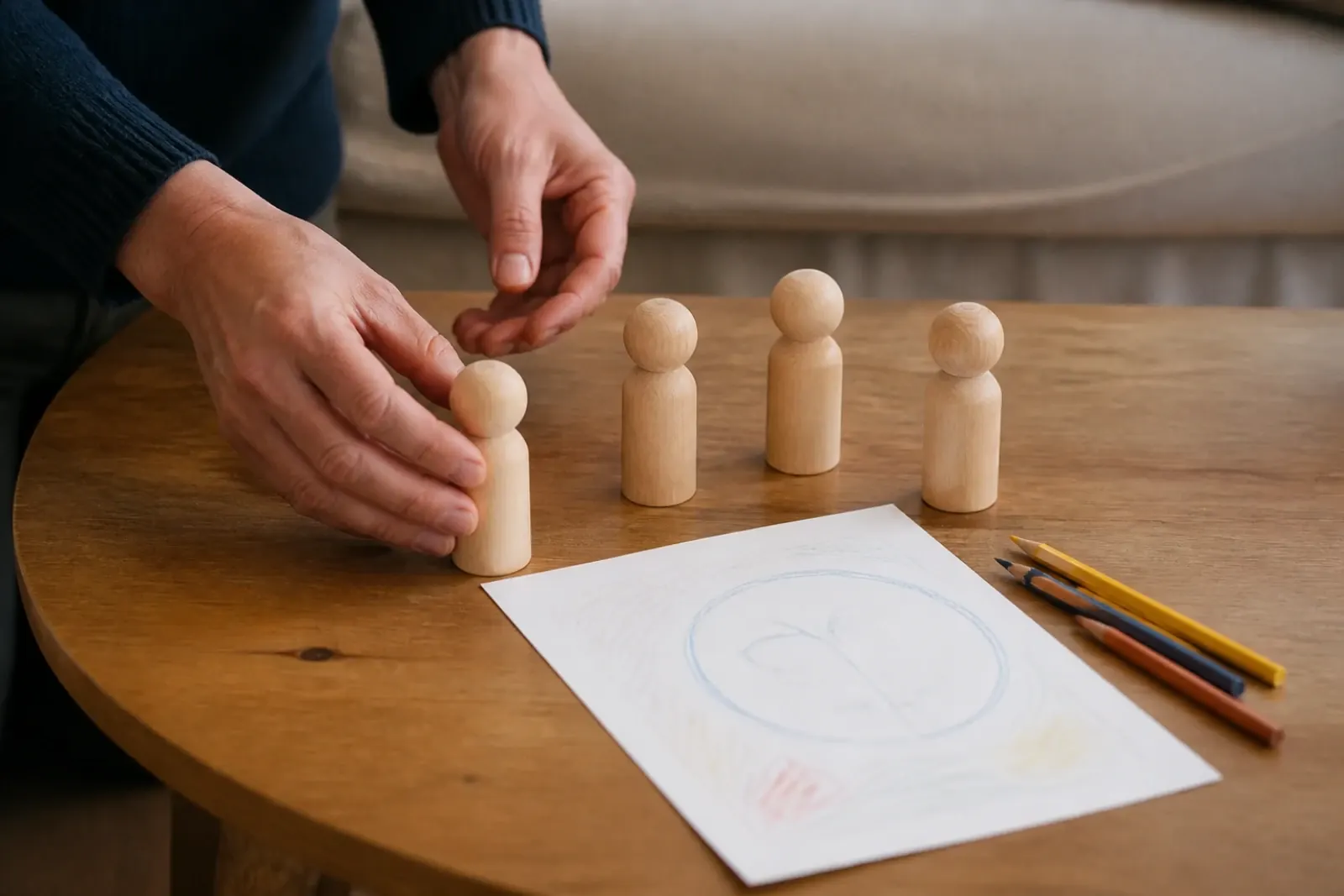
A child sits at a low table with a handful of small figures in front of her. She picks one for her mother, one for her father, one for her younger brother, one for herself. Then I ask her to put them on the table where she thinks they should go. That is how a family constellation with a child begins.
Someone goes here. Someone else belongs over there. These two are close together. This one is looking away.
That is a family constellation, and most children need very little explaining before they can make one. Once the family is out on the table, we have something we can look at together.
Children already do things like this
Children arrange things all the time. They line up figures, they put dolls in houses, they draw their families, they decide who sits next to whom, and they invent whole relationships between toys without explaining any of it first.
A constellation asks for something very similar.
Rather than sitting a child opposite me to tell me what is happening at home, I can hand them figures and ask them to show me. Children do not always have words for what they are living through, and even when they do, saying it out loud to an adult is often the hardest route available. With figures we can start somewhere easier.
Some children would rather draw. Then we take a sheet of paper and put everyone in the family somewhere on it. Someone might be very close and someone far away. One person might be enormous and another tiny. Someone might end up at the very edge of the page.
There is no correct way to make the picture. What matters is that it gives us something the child can see, respond to and change.
What we actually do
I work with a child one to one, in my room or on a screen.
The child chooses figures for the people who matter and puts them somewhere. Then we look at the picture together. My questions stay simple.
Who is closest to you?
Where is Dad looking?
Is this a good place for you?
Where would you rather be?
What happens if we move this one over here?
Sometimes we move a single figure and stop there. Sometimes we try several arrangements. Sometimes a child starts rearranging things the moment they see them.
I am interested in what the child notices. A figure standing far away is somewhere for the two of us to start looking, and the child is the one who says what it is like over there. Whatever meaning the picture has, they are the one who supplies it.
Children surprise the adults around them fairly often. They will care a great deal about something nobody realised mattered, and shrug at the thing everyone assumed was central. That is a good reason to let a child build the picture themselves.
We work at the child’s pace. Sometimes that is remarkably quick. Sometimes we spend a long while getting comfortable before anything much happens at all.
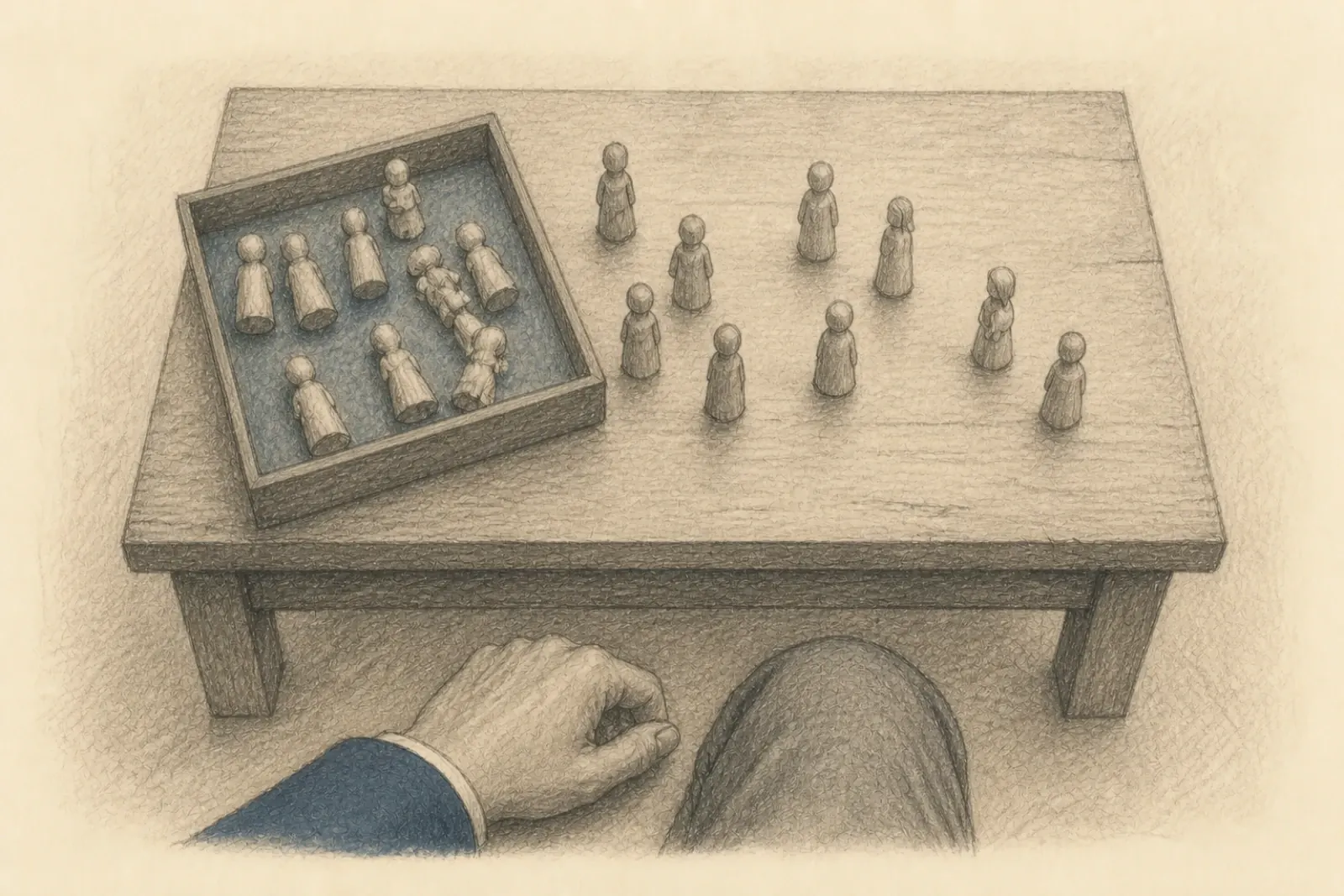
What children bring
Parents contact me for all sorts of reasons.
Sometimes it is school. A child who does not want to go, who is struggling there, who is being bullied, who keeps ending up in trouble.
Sometimes something has changed at home. Parents have separated. Someone has died. The family has moved country. Someone is ill. A new baby has arrived.
Sometimes there is no single event at all. A child has become worried, or angry, or very quiet. Something that used to be manageable has stopped being manageable. Or a parent simply has the sense that their child is carrying something they cannot say.
I cannot tell you in advance what a session will turn up. What a constellation gives a child is another way of showing us what their life is like, before they have to find the words for it.
Different ways to make the picture
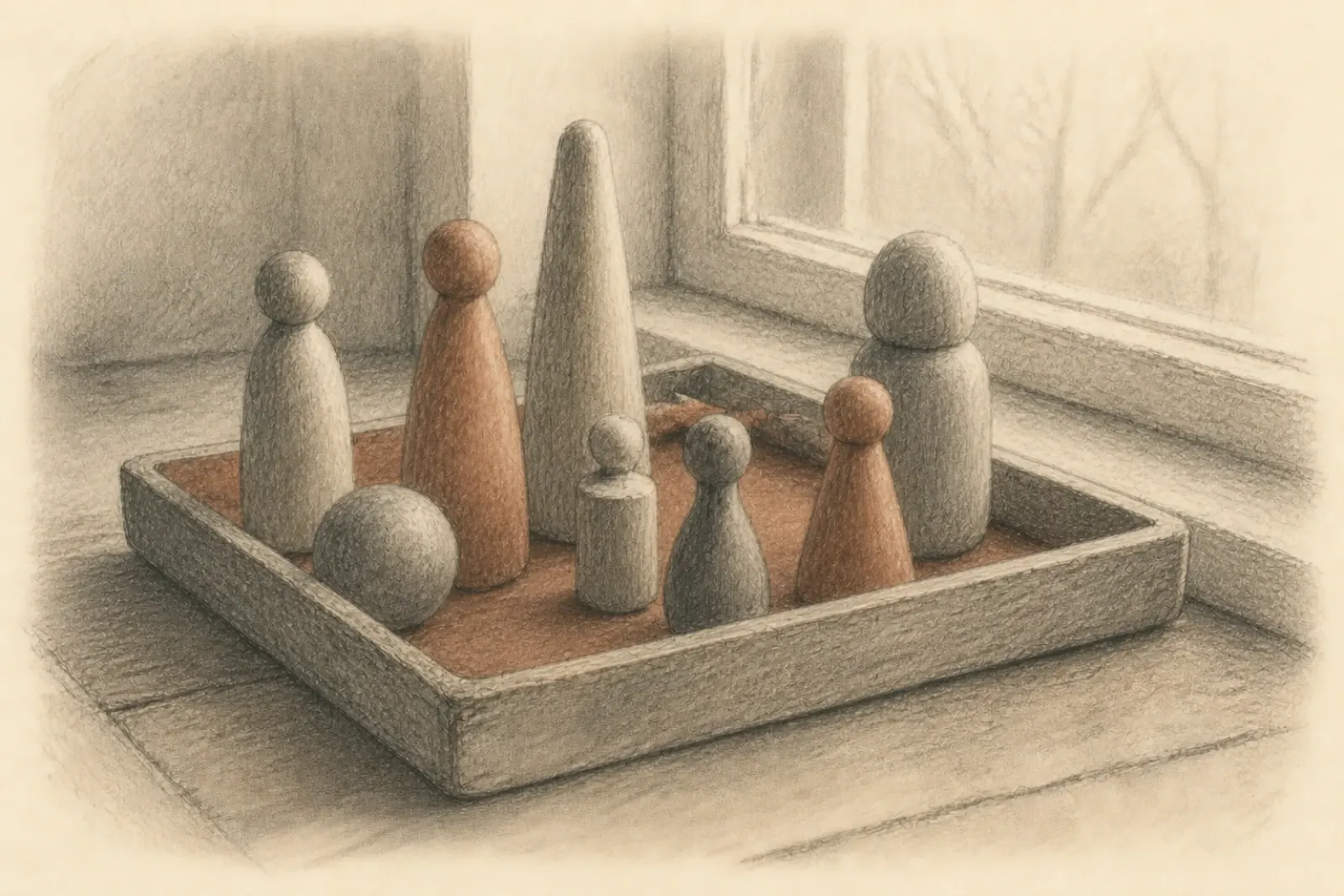
Some children like working with the figures I keep in the room. We can also use toys, objects, drawings, or simply positions in the space around us. What matters is that the child has an easy way to show me where people and things belong without having to explain everything first.
Online, I use a space designed specifically for working with children. They can choose characters, place them, move them around and build the picture with me on the screen. It gives us much of the same freedom we have in the room, but in a form that feels natural to use online.
I usually follow the child. If they immediately reach for the figures, we use the figures. If drawing makes more sense to them, we draw. If a toy becomes the obvious way to show me something, that can become part of the work too.
The tool is there to help them show me their world. It should never become more important than what they are trying to show.
Where you come in
Before I meet your child, I speak with you.
I want to hear what has been happening, what has changed, what worries you, and what you have already tried. Sometimes that conversation tells us a constellation is the wrong place to start, and I would rather say so.
If we do go ahead, whether you are in the room depends on your child, their age, and what we are doing. With a younger child, a parent nearby often makes the whole thing feel ordinary and safe. You are there to be there. Your child gets to make their own picture, and it matters that they make it themselves.
Sometimes the session that helps is the family together, with several of you putting out what you each see.
And sometimes I work with the parent instead. A difficulty that shows up in a child often belongs somewhere else in the family, and the person best placed to shift it may be an adult.
We work that out from your situation rather than deciding in advance who should be in the room.
Afterwards
Your child does not owe you an account of it.
Try not to ask what each figure meant, or why somebody was standing where they were, or what they told me. If your child wants to tell you something, listen. If they want to show you, let them. If they walk out of the room and go straight back to their Lego, that is fine too. They do not have to give you a report for the hour to have done its work.
If this sounds like your child
Write to me and tell me what has been happening. You do not have to work out whether your child needs a session on their own, or the family together, or something else. Tell me what a hard week looks like, what worries you, and anything that has changed lately.
We can start from there.
I work in English, Spanish and Portuguese, in person and online.