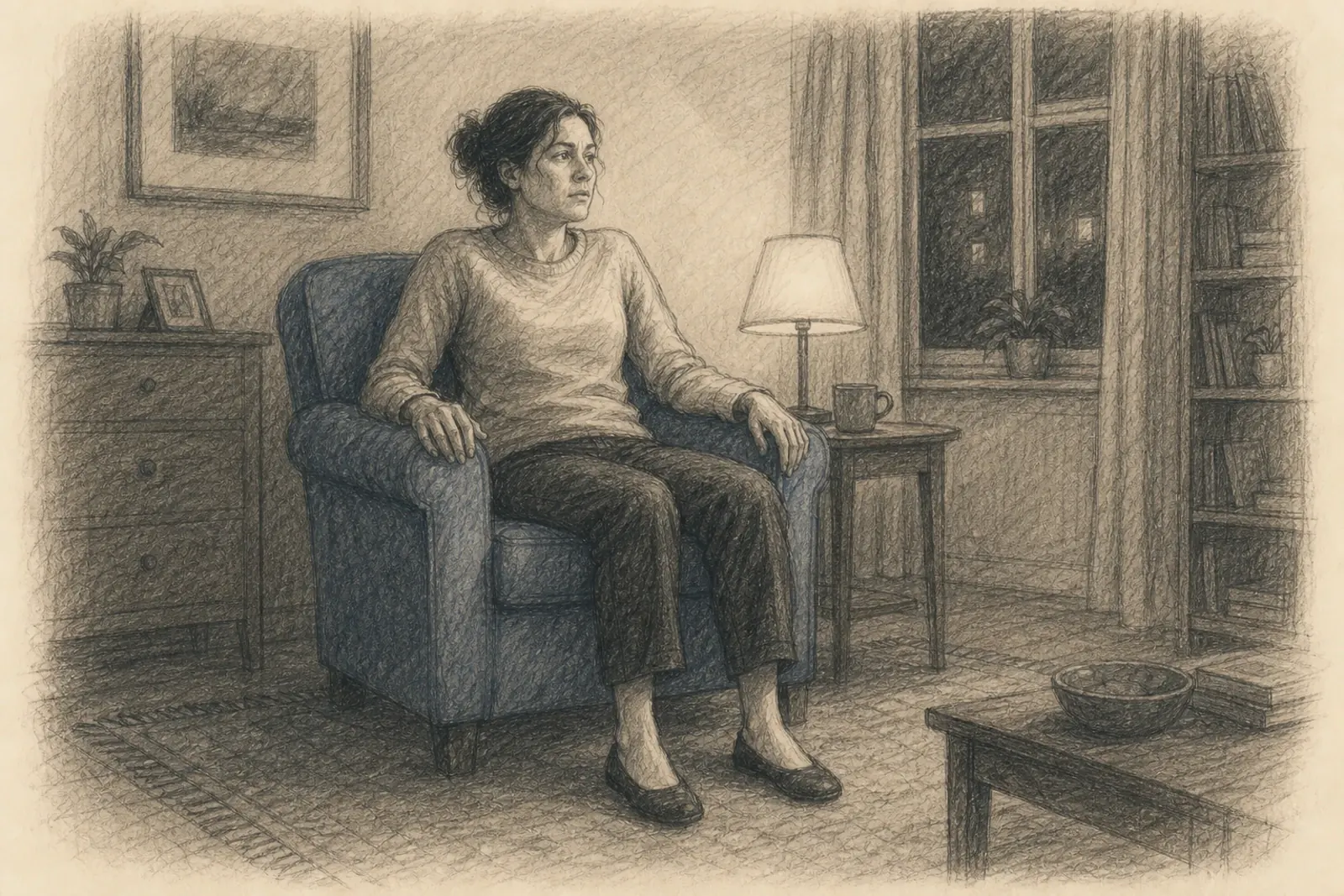
A lot of what your nervous system does happens before you consciously decide what to make of it. Stephen Porges, whose Polyvagal Theory informs part of my work, uses the word neuroception for this non-conscious evaluation of cues of safety and threat.
I see what this can look like in practice every week. Someone sits across from me and says they’re exhausted and wired at the same time. They sleep badly, they startle at small things, they struggle to stay with a book or a conversation. And very often they say some version of the same sentence: “There’s no reason for it. Everything in my life is actually fine.”
Sometimes that sentence is exactly the place to start. The present may look safe on paper, while the body is still responding as if it needs to stay alert. One useful question is whether the nervous system is reacting only to what is happening now, or also to patterns it learned earlier.
The watchman that never clocks off
Underneath much of what you consciously do, your nervous system is continuously taking in information. Tone of voice. Facial expression. Pace. Distance. Movement. Some of that processing happens outside awareness, and you often notice the result before you notice the cue: your shoulders tighten, your breathing changes, your stomach drops, or something in you relaxes.
Most of the time this is useful. You don’t want to reason your way through every doorway or every social encounter. But it means something worth taking seriously: feeling unsafe is not simply a thought, so reasoning with yourself is often not enough to change it. You can know that you are probably safe and still feel on edge. Those two experiences can coexist.
Why it doesn’t always switch off when the danger has passed
Here’s the part I most want you to have, because it changes how people treat themselves.
Your nervous system learns from experience, and past experience can shape how strongly it responds to the present. If there was a time when staying alert helped you cope, in childhood, in a difficult relationship, through an illness, or through years that were simply too much, then vigilance may have become a very well-practised response.
So when it won’t settle now, it isn’t malfunctioning. It’s being faithful to old instructions. I find people soften when they hear this, because they’ve usually spent years treating their own body as the enemy: too sensitive, too dramatic, broken. It isn’t broken. It’s protecting you against something that already ended, and nobody has convinced it yet that the ending happened.
Insight can help, but insight alone is often not enough. Regulation is also learned through repeated experiences of safety, predictability, connection and enough control over what happens next.
The three gears
One useful Polyvagal map describes three broad patterns of autonomic response. I teach this to therapists in training and I draw it for clients too, not because every person fits neatly into three boxes, but because a simple map can make an overwhelming experience easier to recognise.
Settled and social. A state associated with greater flexibility, connection and capacity to rest. Your body is calm enough to digest, think and recover, and open enough to engage with other people. Problems can feel more approachable from here.
Mobilised. The system is preparing for action. Heart rate may rise, muscles tighten, attention narrows or moves outward. This can look like anxiety, irritability, restlessness, urgency, or that familiar tired-but-wired feeling. Useful when action is needed. Exhausting when it becomes the default.
Shut down. When alarm goes on too long, or the threat feels too big to fight or outrun, the system does something older still: it powers down. Flat, foggy, numb, far away from your own life. People in this state often say they feel nothing, and they’re not exaggerating. The system has turned the volume down on everything, including the good.
Some people recognise themselves mostly in mobilisation. Others notice a cycle between agitation and periods of flatness or disconnection. The point of the map is not to diagnose yourself. It is to give the experience a shape, so you have something more useful than “why am I like this?”

What can help it settle
If reasoning is not always enough on its own, the next question is what else the system responds to.
One answer is relationship. Another calm, responsive person can make regulation easier. This is part of what we mean by co-regulation, and it is one reason a difficult conversation can feel different depending on who is sitting across from you. That relational regulation is an important part of good therapy too.
Sound is another route I work with. The Safe and Sound Protocol uses specially filtered music that emphasises frequencies associated with human vocal communication. Within the Polyvagal framework, it is designed to make cues associated with safety and social engagement easier to access. I’ve written separately about how a guided course actually runs on the listening therapy page, so I won’t repeat the practical detail here.
The broader point matters more than any one method: a nervous system that has learned alarm can also learn greater flexibility. Usually not by force, and not through one perfect insight, but through enough repeated experiences in which the body does not have to stay on guard.
Constellation work is another of the ways I work, and building what steadies you is part of it rather than a stage before it. I’ve written separately about family constellations and trauma, and what we build first.
If you’ve read this far and recognised yourself, the reading has done its job. If you want to go further, the listening therapy page explains what a guided course looks like, and if you’d rather start by asking a question, I’m one message away.